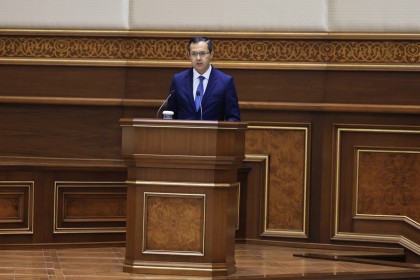
The Central Bank sees no serious risks that could prevent inflation from falling to its target level of 5% in 2027. This was stated by Central Bank Chairman Timur Ishmetov during a plenary session of the Senate of the Oliy Majlis, where the regulator’s annual report for 2025 was presented.
Senator Ikromkhon Najmiddinov pointed out that the Central Bank has been pledging to lower inflation to 5% for several years, yet by the end of 2025, it still remained well above that target.
"As everyone knows, our inflation rate has remained high in recent years. Inflation is a critical factor that directly impacts our citizens' welfare, as well as the cost of loans and the value of savings," the senator said.
He noted that the Central Bank’s report now forecasts achieving the inflation target by 2027.
"How confident is the Central Bank that the inflation target will be met in the coming year? Or are there underlying risks and factors that might force us to once again push back the timeline for achieving this goal?" Ikromkhon Najmiddinov asked.
Timur Ishmetov acknowledged that the regulator has repeatedly deferred the timeline for meeting the inflation target in recent years.
"The reason is that inflation is driven by a wide array of forces—monetary, non-monetary, and external factors. When we formulate a forecast, we naturally account for all these variables and certain baseline estimates. However, over the course of any given year, domestic or external factors can—and do—change," he explained.
He cited past years as an example, when inflation forecasts were heavily disrupted by the prolonged, multi-stage liberalization of energy tariffs.
The Central Bank chief outlined the primary domestic factors driving inflation.
"When looking at the main internal drivers of inflation, they include aggregate demand outstripping the economy's productive capacity, alongside fiscal spending exceeding planned budgetary targets [i.e., when the government spends more than allocated]," he stated.
"Consequently, we do not foresee any severe risks that could abruptly derail us from hitting our target next year. We see no major roadblocks," the Central Bank Chairman said.
However, he emphasized that both internal and external risks remain on the horizon.
Among the domestic risks, Timur Ishmetov reiterated the threat of aggregate demand persistently outrunning the economy's productive capacity.
"In other words, rising household incomes and an expanding money supply must be matched by a corresponding increase in production and the supply of goods. If supply fails to keep up, it will fuel inflation," he explained.
Additionally, he noted that future fiscal spending overruns—a recurring issue in previous years—could continue to exert upward pressure on prices.
Turning to external risks, the Central Bank chief pointed to geopolitical tensions, potential price hikes for imported global commodities—particularly fuel and food—and rising logistics costs.
"A protracted period of geopolitical tension could take a toll. Furthermore, if global import prices surge, especially for fuel and food supplies, it will inevitably impact our market. Escalating logistics expenses could also generate supplementary inflationary pressure," Timur Ishmetov concluded.
Stay up to date with all the latest news: