A major corruption scandal is brewing over the city’s public transit infrastructure. The Anti-Corruption Agency of Uzbekistan, led by Director Akmal Burkhanov, has launched an active investigation into the sweeping modernization of Tashkent’s bus stops. What was promised as a futuristic, accessible upgrade for commuters has instead triggered widespread public outrage, exposing signs of procurement fraud, bid rigging, and specification tailoring.
At the heart of the scandal is a staggering discrepancy between corporate monopoly, official defiance, and the grueling reality of local passengers waiting in the stifling summer heat.
The Red Flags: Monopolies and Missing Paperwork
The watchdog’s investigation highlights classic indicators of a collusive bidding scheme. Under presidential decrees, Tashkent aimed to modernize 1,785 bus stops using the electronic bidding platform, E-auksion. The system was designed to foster open market competition.
Instead, a single private entity—Ewi Snacks—quietly locked down a massive monopoly, securing the lease rights for 266 existing plots and snatching the contracts for 230 additional "social" bus stops.
The Anti-Corruption Agency’s initial findings are damning:
- Zero Signed Handover Certificates: Not a single official sign-off has been executed for the 120 bus stops scheduled for completion in May and June 2026.
- Ghost Infrastructure: Construction remains entirely unfinished at numerous locations, with essential equipment left uninstalled.
- Anti-Competitive Invoicing: The watchdog explicitly recommended breaking future auctions into separate district lots. This confirms suspicions that the original auction structure was deliberately tailored to shut out smaller entrepreneurs and hand a massive public asset to one favored contractor.
Despite the Anti-Corruption Agency's scathing findings, city transit officials are engaged in aggressive damage control. Olloyor Norbutaev, Head of the Public Transport Prioritization Department, claimed to media that over 250 stops are already "fully operational".
In what critics call a blatant example of specification tailoring, Norbutaev drastically lowered the bar for what constitutes a "modern" bus stop. When pressed by journalists on why these newly built shelters are so tiny with no security cameras, or electronic displays, Norbutaev claimed there were never plans for such.
"A bus stop isn't meant to accommodate someone waiting for 30 minutes," Norbutaev stated, shifting the blame to fleet intervals rather than the quality of the physical shelters.
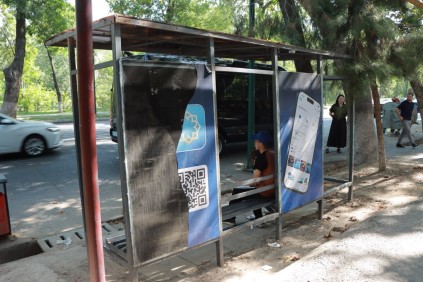
Local journalists and commuters are calling foul on the city administration's rosy narrative. Investigative reporters exposed newly erected stops that amount to nothing more than cheap metal frames and concrete slabs.
Far from providing shelter, the cheap, heat-conducting metal roofs offer no sun protection, forcing passengers to abandon the designated platforms entirely to huddle in the shade of nearby trees. When journalists confronted Norbutaev with evidence of these blistering, low-quality structures, the official deflected, stating that the "movement of shade is naturally dependent on the time of day."
Furthermore, while officials claim only one instance of broken glass exists across the city, passengers report widespread damage, missing panels, and unfulfilled promises.
The Investigation Focus
The Anti-Corruption Agency has issued a formal ultimatum to the Tashkent City Administration. The agency demands immediate enforcement of contractual obligations and tight oversight to ensure the contractor delivers structures that meet genuine technical standards—not just cheap, scaled-back skeletons.
As public anger intensifies, the investigation will now look into how a snack company cornered the market on city infrastructure, and where the budget went if all commuters received were cheap metal frames in the Uzbek heat.
What is Wrong with cheap-framed tiny over $10,000 bus stops? Everything!
In early June, Tashkent mayor Shavkat Umurzakov addressed the demolition of retail shops at bus stops in an interview with Kun.uz, emphasizing that these transit hubs must meet established standards and serve an entirely public function.
According to the mayor, the capital currently has around 2,500 bus stops, with plans to expand the network to 3,500 in the future. However, over 1,000 of the existing structures fail to meet modern requirements.
Shavkat Umurzakov noted that commercial shops built into bus stops create severe traffic bottlenecks. Cars frequently double-park near these retail outlets, blocking buses from pulling up to the curb. Furthermore, litter accumulates rapidly, and the spaces become cramped and uncomfortable for waiting commuters. In some instances, entire passenger pavilions were locked up whenever the private shops closed, forcing commuters to wait out in the elements.
The Mayor promised that the new bus stops will be built to international standards, equipped with emergency panic buttons, Wi-Fi, real-time transit displays, and other amenities. Plans also include installing vending machines for water and light snacks.
Each new stop is estimated to cost between $10,000 and $20,000. The project is being rolled out through a public-private partnership (PPP) model, where private partners fund the initial construction and handle ongoing maintenance in exchange for revenue from advertising and vending services.
Business owners whose shops were demolished are being offered alternative commercial spaces elsewhere in the city, Umurzakov added.
"Our ultimate goal is to create a convenient, user-friendly environment for residents and public transit alike. A bus stop must function as a public utility, not a commercial marketplace," the mayor stressed.