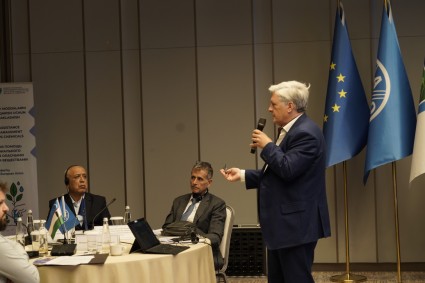
The Food and Agriculture Organization of the United Nations (FAO), together with the Waste Management and Circular Economy Development Agency of Uzbekistan, convened government and cement industry representatives in Tashkent today to discuss the potential of cement kiln co-processing to support the environmentally sound management of hazardous waste in the country.
The national roundtable was organized under the European Union-funded project “Technical Assistance for Sound Management of Hazardous Chemicals” and brought together representatives of international organizations, development partners, government institutions, the Cement Industry Association of Uzbekistan and cement producers.
Uzbekistan currently has limited capacity for the disposal of hazardous waste, creating significant environmental and public health risks. In this context, the roundtable explored the role the cement industry could play in managing certain hazardous waste streams through the co-processing of alternative fuels and raw materials (AFR). Cement kiln co-processing is used in several countries as one option for the environmentally sound management of selected waste streams.
Participants also drew on experience from Azerbaijan, where FAO supported a controlled co-processing trial involving pesticide waste containing persistent organic pollutants (POPs). The discussion also considered the Uzbek cement industry’s perspective on co-processing as a business and investment decision.
The roundtable helped identify initial regulatory, permitting, infrastructure and investment issues that would need to be addressed for any future pilot activity.
Roberto Aparicio, Programme Manager at the Delegation of the European Union to Uzbekistan, welcomed the roundtable as an important opportunity to bring together the relevant stakeholders and stressed the importance of translating these discussions into a concrete, jointly agreed roadmap with the relevant government institutions and industry representatives. He reiterated the EU’s support for moving from dialogue to practical next steps on environmentally sound hazardous waste management.
“Uzbekistan has an opportunity to explore cement kiln co-processing as one of the options for strengthening the environmentally sound management of certain hazardous waste streams. This roundtable is an important first step in bringing government and industry together to assess existing capacities, identify interested cement plants and determine the technical, regulatory and environmental requirements that would need to be met before any pilot operation could be considered,” said Artur Shamilov, FAO Agricultural Officer and the Project Lead Technical Officer.
As a next step, interested cement plants may be identified for plant-level technical assessments, paving the way for possible pilot operations that could contribute to the country’s broader approach to hazardous waste management.
Background
The project “Technical Assistance for the Sound Management of Hazardous Chemicals” (GCP/UZB/017/EC), funded by the European Union and implemented by FAO, is a EUR 3.9 million initiative that contributes to reducing environmental degradation in Uzbekistan through improved pesticide management and the promotion of sustainable agricultural practices. The project is part of broader European Union support to the Government of Uzbekistan to strengthen food safety, promote sustainable and efficient land and water use, and foster inclusive agricultural value chains.