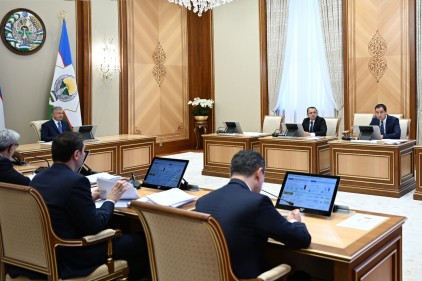
The President Shavkat Mirziyoyev today reviewed a series of proposals aimed at reforming the national pension system.
Over the past decade, pension payouts in the country have increased 3.3-fold, with the minimum pension now set above the minimum consumer expenditure threshold. Prior to 2021, approximately 1.1 million citizens received pensions under 400,000 soums. Today, the minimum pension stands at 878,000 soums, comfortably outpacing the minimum consumer expenditure baseline of 715,000 soums.
In developed nations, accumulated pension funds serve as a vital source of long-term capital for the economy. Projections indicate that structuring Uzbekistan's pension system effectively could unlock substantial, long-term economic investment. This assessment is backed by experts from the International Monetary Fund, the World Bank, the Asian Development Bank, and the International Labour Organization. Consequently, officials emphasized the necessity of modernizing the pension framework based on advanced international best practices, with a specific focus on expanding defined-contribution, private, and corporate pension models.
Currently, only 0.1% of a citizen’s wage is allocated to their funded pension account. Furthermore, the 10% annual interest rate paid on these funds is nearly half of what typical commercial bank deposits yield. To boost the system's appeal and encourage active public participation, new financial incentives have been proposed.
Under the new plan, if a citizen earning a monthly salary of up to 7.6 million soums (equivalent to 15 times the base pension calculating amount) contributes 5% of their wage to a funded pension account, the government will pitch in an additional 2.5% match. For individuals earning above 7.6 million soums, the proposal suggests redirecting 1% of the social tax paid on the amount exceeding that threshold straight into their funded pension account.
The proposals also outline improvements to the method used for calculating pension amounts. Currently, pensions are determined based on an individual's earnings over any five-year block within their final ten years of employment. Furthermore, any portion of a salary exceeding 6 million soums is excluded from the calculation, which in certain cases inadvertently lowers a citizen's average pension payout.
To remedy this, officials proposed extending the wage tracking period used for pension calculations from 5 years to 20 years, while allowing certain periods of low earnings to be excluded from the formula entirely. Additionally, starting in 2027, the maximum salary cap factored into pension calculations is set to rise from the current 6 million soums to 6.6 million soums. Estimates show that under this new framework, individuals retiring in the future could see their pension amounts increase by roughly 8% compared to current rates.
The president emphasized that updates to the pension system directly impact the lives and futures of millions of citizens, underscoring the absolute necessity of meticulously evaluating the socioeconomic impact of every single proposal. He mandated that these matters be opened up for public consultation, engaging citizens, the broader public, media outlets, and bloggers to clearly communicate the goals and anticipated benefits of these reforms.
Finally, responsible officials were instructed to thoroughly study international best practices and submit a bill establishing the framework for private and corporate pension systems.
Stay up to date with all the latest news: