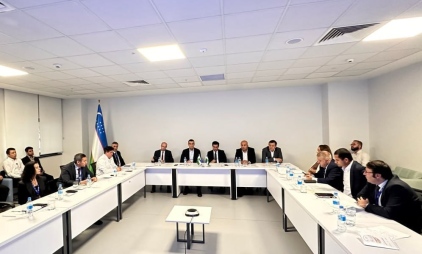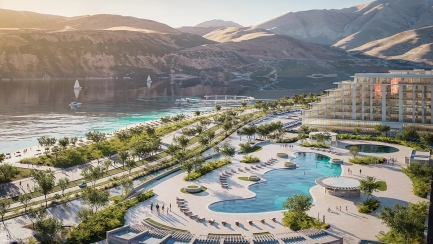
The Tashkent Province branch of the Center for State Environmental Expertise has approved the phase II of the environmental impact assessment (EIA) for Sea Breeze Uzbekistan, a year-round resort complex planned on the eastern shore of the Charvak reservoir. The positive opinion was issued on September 10 and is valid until September 10, 2029.
The phase I of the EIA passed state environmental review on February 10, 2026. The developer was then instructed to carry out additional engineering-geological, hydrological and geodynamic studies, assess mudflow and landslide risks, and clarify the project's impact on air, water, soil and biodiversity. It was also told to assess the cumulative impact of recreational construction, traffic and utilities along Charvak's eastern shore.
The developer was further required to conduct geobotanical and zoological surveys, draw up a biodiversity management plan, and provide for the preservation or replanting of valuable trees. Other requirements included dust control during construction, safe waste handling, land reclamation and an emergency response plan.
According to the opinion, the second-phase materials include engineering-geological findings, air-impact calculations that account for traffic loads, water consumption and discharge data, an analysis of construction and household waste, a cumulative impact assessment and a biodiversity management plan.
The project will be implemented in phases. The phase I occupies 180 hectares along the eastern shore of the Charvak reservoir, below the 4R10 highway, between Boladala and the Kalashsay valley. More than 32.4 hectares of the site are wasteland and ravines, and the rest is occupied to varying degrees by orchards and vineyards.
According to the developer's materials, no hazardous slope processes were identified on the first-phase site. The mudflow- and landslide-prone part of the Kalashsay valley is not included in its boundaries.
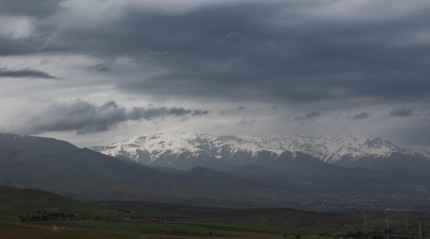
The situation is different on the mountain slopes above the 4R10 highway, the opinion says. They face risks of landslides, erosion and mudflows. The review states that building there is not possible without additional surveys and a package of slope stabilization measures, which would take two to three years of research and engineering work.
The document notes that these slopes were originally part of the planned 557-hectare complex. They are not covered by the current EIA, and no master plan has been submitted for the mountain area above 1,000 meters. Large areas of natural walnut and fruit forests remain there, along with terraced slopes planted with juniper.
60% of the site to be landscaped
The 180-hectare phase I is divided into three planning districts: North (39.2 hectares), Central (102.8 hectares) and South (38 hectares).
Under the master plan, 24.1 hectares, or 13.4% of the territory, is allocated to buildings. Roads and sidewalks will occupy 18.3 hectares, parking 12.9 hectares, sandy beaches 12.2 hectares and artificial ponds 3.4 hectares.
Some 79.2 hectares are earmarked for ornamental landscaping. Another 14.1 hectares are to be natural green zones along drainage valleys, 8.5 hectares coastal vegetation and 7.3 hectares walnut and fruit forests. The project puts the total share of green space at 60.6%.
The resort is expected to include parks, swimming pools, beaches and amusement rides. Roads and driveways within the complex will total 13.6 kilometers. A gas station and car service center are to be located outside the resort, along the 4R10 highway.
The Charvak reservoir's water protection zone along the complex will extend for 4.8 kilometers and is 100 meters wide. It includes the shoreline strip up to the 920-meter mark, taking into account the reservoir's maximum fill level of 896 meters, forced backwater level of 891.25 meters and normal backwater level of 890 meters.
The 8.5-hectare shoreline strip lies within the resort's boundaries, but no construction is planned on it. Warning signs, information boards and observation points are to be installed along its edge.
Two dacha plots with four single-story buildings stand in the northwest. The EIA materials say they lie within the 100-meter protected shoreline zone and must therefore be demolished.
In the floodplain and channel sections of the Chashmasay and Gulsarysay streams, 4.1 hectares of valley forest are to be preserved. On the left slope of the Gulsarysay, five areas of walnut and fruit forest totaling 7.3 hectares will also be kept. The 8.5-hectare shoreline strip is to remain free of buildings.
According to the submitted materials, no plant or animal species listed in the Red Book have been found on the first-phase site itself.
Valuable trees to be preserved, replanted or compensated for
The review required full preservation or replanting of valuable trees and shrubs, including walnut. Where other plantings cannot be preserved or replanted, compensatory planting is required at a ratio of 10 trees for each one removed.
Removing trees before a survey is carried out and the necessary approvals are obtained is prohibited.
The project materials also mention preserving or replanting Zeravshan juniper, walnut and Sievers apple trees. Trees remaining on the construction site must be fenced off. Building materials and machinery may not be stored closer than 2.5 meters to trees or 1.5 meters to shrubs.
The developer was also told to clarify the volume of topsoil to be removed and to draw up a plan for reclaiming disturbed land. According to project calculations, about 726,000 cubic meters of topsoil will be stripped during construction, stored temporarily and later reused for landscaping.
Water from Charvak, and a separate review for the sewer line
For technical needs during construction, water is to be drawn from the Charvak reservoir through a temporary shoreline intake. Drinking and household water for workers will come from the existing Boladala water supply.
Total water consumption during construction is estimated at 722,300 cubic meters, of which about 720,000 cubic meters will go to industrial and technical needs.
Once the resort is operating, water will be drawn from a floating platform 100 meters from shore. The main drinking water pipeline from the platform to Boladala and Yakkatut will run 14 kilometers, with another 13 kilometers of internal networks. The complex's own water use is estimated at 734,300 cubic meters a year.
Separately, the project provides for about 3.29 million cubic meters of water a year to irrigate green areas, beaches and paved surfaces. About 1 million cubic meters, according to the materials, will flow into the drainage network and on into the Chashmasay and Gulsarysay.
For household wastewater during construction, the developer initially specified modular treatment units with a capacity of up to 10 cubic meters a day. The review found that insufficient given the likely increase in the workforce.
With a peak workforce of up to 800 people, estimated wastewater volume from the main sources alone could reach 100-116 cubic meters a day. The developer was therefore ordered to provide local treatment facilities with a combined capacity of at least 200 cubic meters a day.
Household wastewater must be treated to a level of at least 80%. The review separately requires that no untreated or insufficiently treated wastewater reach the Charvak reservoir, the Chashmasay, the Gulsarysay or other waterways.
Sewage collector to cross the reservoir
Once the complex opens, household wastewater is to be sent to the Bokachul sewage collector, which would be extended from Charvak's western shore to its eastern shore.
The new 1,420-meter section would cross the reservoir at its narrowest point. Two steel pipes with a diameter of 426 millimeters, one working and one backup, are to be laid on concrete piles inside a protective casing. The wastewater would then flow to the Chirchik treatment facilities.
The environmental review stated explicitly that this sewer crossing must be treated as a separate project. Its construction and operation require a separate EIA and a new state environmental review.
The developer was also instructed to provide backup power for pumping stations and treatment facilities, and automatic emergency shut-off valves on pressure pipelines.
The opinion lists possible emergencies: a ruptured sewage collector, pumping station failure, power outage, overflowing tanks, damage to the pressure water pipeline and an emergency discharge of untreated wastewater.
For each scenario, the developer must determine the likely impact zone, the volume of pollutants, how fast they would spread and the containment measures. It must also prepare an emergency response plan and a system for alerting and evacuating residents from potential flood zones, involving the hokimiyat, the Emergency Situations Ministry and mahalla community bodies.
A separate environmental monitoring program must include checks on water quality upstream and downstream of the site, turbidity and suspended solids during work in waterways, and the condition of slopes and landslide activity.
Construction emissions
The EIA materials estimate total emissions of 14 pollutants from five stationary and unorganized sources during construction at 132.25 metric tons.
Most comes from carbon monoxide (56.2 tons), nitrogen dioxide (18.8 tons), hydrocarbons (17.2 tons) and inorganic dust (12.8 tons). According to the submitted materials, calculations of maximum ground-level concentrations beyond the construction site showed no breaches of set standards.
Emissions from mobile sources, such as construction machinery and vehicles, are estimated separately at 692.9 tons over the construction period. The opinion says the impact on air during construction will be temporary.
To reduce dust, the review required that construction sites be watered, that vehicles not meeting the Euro 5 standard be restricted, and that the technical condition of machinery be monitored.
Positive opinion is not a construction permit
The Tashkent Province branch of the Center for State Environmental Expertise ultimately approved the phase II of the Sea Breeze Uzbekistan EIA.
The opinion stresses, however, that a document finding a project permissible is not a permit and does not remove the need to obtain the permits required by law.
The opinion is valid for three years. If project designs change or environmental requirements are not met, a new EIA may be required or the opinion may be revoked.
Before the complex begins operating, Sea Breeze Uzbekistan must also pass a final EIA phase, for which it will have to submit materials reflecting the requirements of the current opinion.
Ecology committee: no violations found during site visits
Uzbekistan's National Committee for Ecology and Climate Change said on September 30 that the first and phase IIs of the Sea Breeze environmental impact assessment have been completed and have received state environmental review opinions.
The committee stressed that environmental assessment of the project continues as it progresses, and that a final phase is planned after construction and before the facilities are commissioned.
In addition to state oversight, members of a Public Council are monitoring the project, the agency said. They visit the site to check the condition of green spaces, waste handling and compliance with environmental measures.
The committee said no violations of set environmental requirements have been found during the visits so far.
On August 1, 2025, the Uzbek government approved measures to create the Sea Breeze Uzbekistan resort. The investor receives a 25-year lease on 577 hectares of land at a reduced price and may build while documentation is still being prepared. The measures also allow trees to be relocated without compensation.
British architecture firm Scott Brownrigg was brought in to draw up the master plan quickly.
Responding to questions about the planned resort, the Ministry of Investments, Industry and Trade said it is being built with private investment and no budget funds. Land rent has been reduced as an incentive, but the investor must pay $240 million. "This is a chance for Charvak to become a year-round hub for tourism, work and comfortable living," the ministry said.