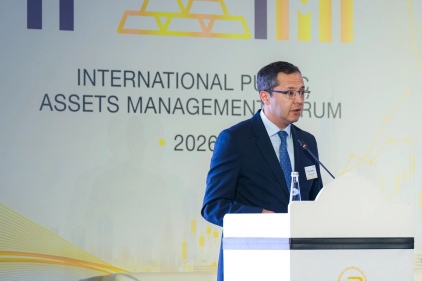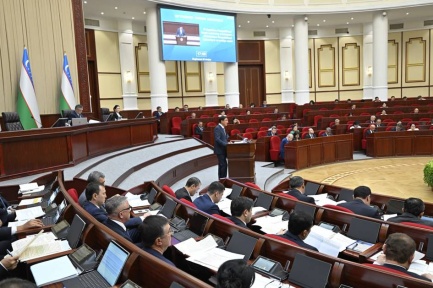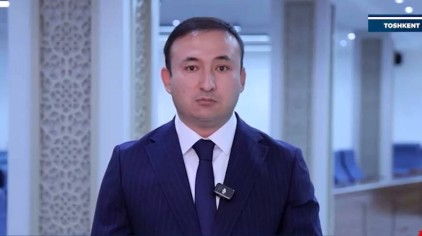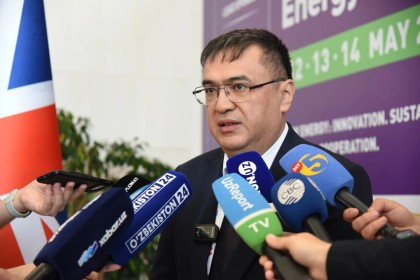
The entry of international energy giant BP into the production sharing agreement (PSA) for the North Ustyurt blocks will accelerate the project's timeline and elevate it to a much higher technological standard, Nodir Mukhiddinov, Chief Geologist of Uzbekneftegaz, told reporters on May 13.
According to Mukhiddinov, bringing BP on board secures the participation of a "world-renowned, highly advanced, and deeply experienced company with massive potential in the oil and gas sector."
"This partnership creates a prime opportunity to discover promising new gas and oil fields in Ustyurt, conduct extensive geological exploration across potential sites in the region, and tap into new reserves," the chief geologist stated.
When questioned about the scale of BP's financial commitment, the Uzbekneftegaz official noted that the exact investment volume will be determined by the specific terms outlined in the production sharing agreement.
The agreement covers the Boyterak, Terengkuduk, Birkori, Kharoy, Karakalpak, and Kulboy blocks, all located within the Ustyurt region of Karakalpakstan. The project will be executed as a joint venture alongside Uzbekneftegaz and SOCAR.
BP acquired a total 40% stake in the PSA, purchasing a 20% share from each of the existing partners, SOCAR and Uzbekneftegaz. Following BP's entry, the revised equity distribution in the PSA stands at 40% for BP, 30% for Uzbekneftegaz, and 30% for SOCAR, which will retain its role as the operator.
"Right now, the primary objective of this agreement is exploration - specifically, discovering new fields. Once we identify new resources and fields, and subsequently begin extraction and delivery, only then will we negotiate product allocation. At this stage, our immediate priority is finding new deposits through exploration. The core mission of this venture is to discover new fields and map out fresh reserves," Nodir Mukhiddinov explained.
He added that both SOCAR and BP, as highly experienced multinational corporations, fully account for the geological and technological risks inherent to the project.
Addressing concerns regarding the benefits for Uzbekistan, the chief geologist emphasized that the fields themselves will remain the sole property of the state and will not be transferred to foreign investors.
"Uzbekistan's interests are robustly protected. First and foremost, Uzbekneftegaz retains a major, substantial equity share under the agreement. Second, it is crucial to understand that even after a discovery is made, the field remains the property of Uzbekistan. In other words, only the extracted resources will be shared in the future based on the contractual formula. The asset itself belongs to Uzbekistan; ownership of the entire field is never handed over to foreign entities," he stated.
According to Mukhiddinov, production sharing will only commence after a field is discovered and the project yields tangible results.
"Product distribution will only take effect under an agreed-upon mutual sharing framework after we uncover a field and start seeing returns. The terms ensure that the interests of all parties - and first and foremost, the economic interests of Uzbekistan - will be heavily prioritized in this agreement," Mukhiddinov noted.
He also confirmed that a portion of the extracted resources will be allocated to satisfy domestic energy needs. According to the chief geologist, the initial phase of the project is scheduled to run for five years, with subsequent developments depending entirely on the results of these early operations.
When asked exactly what percentage of the output would supply the domestic market versus being earmarked for export, Nodir Mukhiddinov declined to comment, stating that these are proprietary commercial details that cannot be disclosed at this time.
"Following the completion of geophysical surveys, our immediate next step will be deep exploratory drilling. Only after that phase is complete can we realistically discuss confirmed reserve volumes," he explained.
About the Project
Under the terms of the agreement, prospecting, exploration, and the drilling of at least one deep exploratory well must be completed within the five-year window. SOCAR will serve as the project operator throughout this initial timeline.
The Uzbekistan 24 TV channel previously reported that the project anticipates the discovery of up to 100 million tons of oil and 35 billion cubic meters of natural gas. Industry specialists believe these blocks could yield a major, high-resource field discovery.
SOCAR and the British multinational BP have long eyed Karakalpakstan’s Ustyurt region. In May 2018, Uzbekneftegaz, SOCAR, and BP Exploration (Caspian Sea) signed a memorandum offering the companies an opportunity to jointly study the Aralomor, Sam-Kosbulak, and Baiterek investment blocks on the Ustyurt plateau.
BP initially pulled out of the Ustyurt oil and gas exploration project in 2021. At the time, the British energy giant attributed its exit to a pivot toward green energy and a freeze on new hydrocarbon investments. However, BP has since shifted its global strategy once again - scaling back its previous commitments to cut oil and gas production by 2030 in a bid to focus on high-yield hydrocarbon ventures to boost investor returns.
Stay up to date with all the latest news: