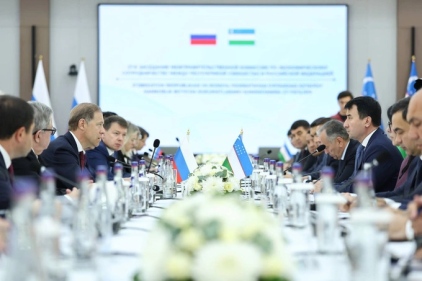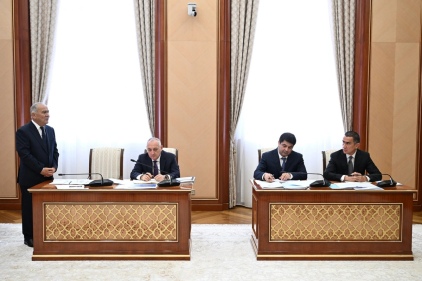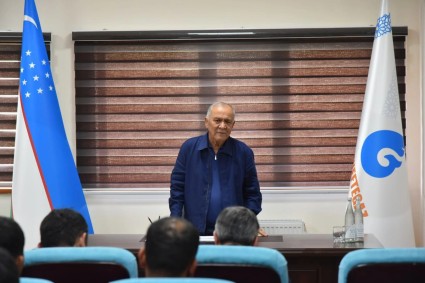
The Gazli Oil and Gas Production Department of Uzbekneftegaz recently hosted a meeting to review natural gas production levels, address field-specific challenges, and discuss strategies to boost output. The session was chaired by Abdugani Sanginov, the Chairman of Uzbekneftegaz.
During the meeting, officials analyzed the "natural decline" in production across several gas fields, pointing to dropping reservoir and wellhead pressures as the primary causes. Company leadership sharply criticized the occurrence of more than 10 emergency shutdowns since the beginning of the year, issuing strict directives to prevent any future operational disruptions.
To address these challenges, the company will draft a specialized program aimed at scaling up geological and technical interventions, restoring production levels, and driving operational efficiency. Management was instructed to swiftly resolve existing bottlenecks and eliminate emergency downtime.
The meeting also reviewed a key decision made in January to retain control of 21 gas fields rather than outsourcing them to an external operator, opting instead to manage operations using Uzbekneftegaz’s internal resources and capacity. Under this strategy, drilling operations were scheduled for 9 sites; to date, work has been completed at 5 of these locations, and they have successfully been put into operation.
The Chairman Sanginov emphasized that the industry must abandon its passive, "go-with-the-flow" mindset. He stated that operations must now be driven by cutting-edge technological solutions, modern management approaches, and proactive leadership.
The meeting also reviewed production targets for 2026. The current plan aims to secure an additional 1.4 million cubic meters of natural gas per day by drilling 9 new wells and repairing 27 existing ones.
According to company data, 5 new wells were brought online and 15 others were repaired between January and May of this year. These efforts successfully boosted daily output by 908,000 cubic meters.
Additionally, officials evaluated the status of all 461 wells managed by the department. The analysis revealed that 45 percent of them require repairs or restoration work. Management was instructed to overhaul another 10 wells by the end of the year to lift daily production by an extra 250,000 cubic meters.
Following the review, the head of the Doyakhotin gas field—which has been operational since 2004—was dismissed from his post for failing to take adequate measures against the natural decline in production. The department director and the chief geologist were also issued formal reprimands.
The session further addressed the reliable operation of compressor stations, the development of power supply infrastructure, and accelerating the construction of transmission lines for wellhead compressor units.
As of 2021, the Gazli Oil and Gas Production Department stood as one of Uzbekneftegaz’s core production and processing units. It accounts for roughly 10 percent of the company’s gas treatment capacity, with a design capacity of 7.69 billion cubic meters per year.
The department’s production complex is also designed to compress 5.1 billion cubic meters and desulfurize 4.5 billion cubic meters of raw gas annually. Furthermore, the Gazli unit historically accounted for about 11.8 percent of Uzbekneftegaz’s total liquefied petroleum gas (LPG) production capacity, yielding 80,000 tons per year.
By 2024, its share in total gas production rose to 14.3 percent. The Mubarek department held the top spot at 43.4 percent, followed by the Shurtan department at 27.8 percent, and the Ustyurt department at 14.4 percent.
During the first quarter of the year (January–March), Uzbekistan produced 9.6 billion cubic meters of natural gas. This represents a 15 percent drop compared to the same period in 2025, when output reached 11.3 billion cubic meters.
In March alone, production volume stood at 2.7 billion cubic meters. Compared to March 2025, output plummeted by 1.2 billion cubic meters, or 30.8 percent. Energy Minister Jurabek Mirzamahmudov then said that the decline was anticipated, noting that the primary goal right now is to stabilize production and sustain current volumes.
By the end of last year, Uzbekneftegaz produced 25.2 billion cubic meters of gas, falling short of initial forecasts. The company's strategy for 2026–2027 focuses on securing stable production volumes while expanding gas reserves and processing operations.
Stay up to date with all the latest news: