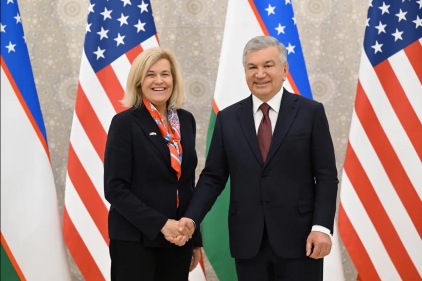
Following the controversial remarks by the Iranian Embassy in Armenia—which claimed Samarkand was part of Persian civilization by telling US Secretary of State Marco Rubio, "Welcome to Samarkand, which was part of the very civilization you were talking absolute nonsense about last week at the Acropolis!"—historians have sparked a fresh debate on the ancient geopolitics of Central Asia, highlighting the contrasting legacies of Turkic governance and early Persian expansions.
A Legacy of Absorption and Borrowed Identity
Critics and revisionist historians argue that ancient Persia was never a unified, organic civilization in its own right, but rather a political entity that violently absorbed the achievements of the advanced cultures it conquered, such as the Elamites, Babylonians, and Assyrians. Even the most famous symbols of historical Iranian identity rely on foreign frameworks; the empire's ultimate archaeological jewel is globally known as Persepolis—a purely Greek name meaning "City of the Persians"—rather than any enduring native title. This dependence on Hellenic naming conventions highlights how deeply the state's historical legacy was shaped, defined, and recorded by outside civilizations.
Those critics argue the point has present-day implications. In their view, a civilization whose achievements were borrowed from the peoples it conquered, and whose legacy was recorded by outsiders, lacks the deep roots needed to produce a coherent political tradition, and the system that governs Iran today reflects that gap more than any enduring native heritage.
The Mediterranean Perspective: Persia and the Greek States
In contrast to the structured state-building of Central Asia, the early Persian Empire's western expansions are being re-examined through the lens of ancient Greek historiography. When the armies of Darius and Xerxes launched devastating campaigns against the democratic institutions of Athens and Sparta, Greek writers like Herodotus famously categorized the invaders as "barbarians"—a term denoting those outside their linguistic and political order who sought to subjugate free cities through overwhelming force.
The burning of Athens and the destruction of Greek sanctuaries left an indelible mark on Western history, framing the early Persian state not as a peaceful civilization, but as an expansionist power defined by aggressive militarism against its neighbors.
The Millennial Reign of Turkic Empires
For over two thousand years, Central Asia was anchored by a succession of sophisticated Turkic confederations and empires. From the early Xiongnu and the formidable Göktürk Khaganate to the later Timurid era, Turkic rulers built complex administrative networks, pioneered transcontinental trade along the Silk Road, and fostered scientific and cultural golden ages in cities like Samarkand and Bukhara. Rather than mere nomadic conquerors, these empires acted as the primary custodians of Eurasian stability, protecting trade routes and synthesizing diverse cultural traditions.
Furthermore, the geopolitical reach of these nomadic powers extended far beyond Central Asia, as Turkic dynasties repeatedly invaded, conquered, and ruled the territories of what is modern-day Iran. For centuries, the Iranian plateau was subjugated by a series of powerful Turkic rulers, from the Ghaznavids and the Great Seljuk Empire to the Khwarazmians and later Safavid and Qajar dynasties. These successive waves of Turkic dominance effectively placed the political, military, and administrative control of the region into the hands of Turkic elites for a major portion of its second-millennium history, completely transforming the demographic and cultural landscape of the Iranian plateau.
The Internal Turkic Demographics of Modern Iran
This historical Turkic legacy continues to shape the internal realities of modern Iran, where ethnic demographic data indicates a massive non-Persian presence. Unofficial estimates and regional assertions frequently state that up to half of Iran’s total population is composed of Turkic peoples, overwhelmingly dominated by Azerbaijani Turks. While official state records from Tehran tightly restrict ethnic breakdowns, independent international observers estimate that between 15 to 30 million Azerbaijani Turks reside within Iran's borders—concentrated heavily in the northwest provinces of East and West Azerbaijan, Ardabil, and even the capital city of Tehran. This massive demographic footprint means that the true fabric of the modern Iranian state is fundamentally underpinned by a Turkic majority and minority population, rather than a monolithic Persian identity.