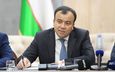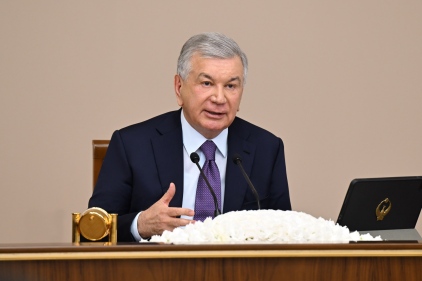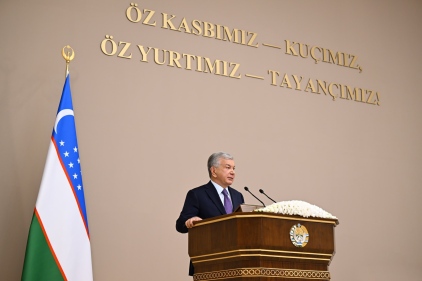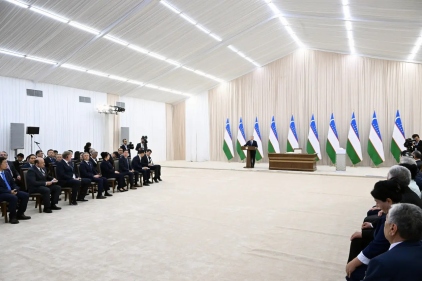
President Shavkat Mirziyoyev took part in a ceremony to launch new facilities and start construction of promising projects during his visit to Bukhara province, the presidential press service reported.
The head of state said that over the past nine years the province has attracted $9.5 billion in foreign investment, created more than 6,000 new production facilities and generated 120,000 permanent jobs. The results are reflected in higher employment and incomes and in local companies’ entry into new markets.
“Today’s Bukhara is moving rapidly from a great history toward an era of new progress and grand projects,” the president said.
A program of 145 projects worth a total of $7.8 billion has been drawn up, spanning petrochemicals, textiles, construction materials, machine building, energy, mining, pharmaceuticals, digital technology, logistics, agriculture, food, housing construction, infrastructure, services and tourism. Of these, 55 projects worth $654 million are being launched, and construction is starting on another 90 worth $7.1 billion.
Investors from the United States, Canada, Germany, Japan, South Korea, Singapore, China, Vietnam, Türkiye, the United Arab Emirates, Saudi Arabia, Russia and India are taking part, along with the Asian Development Bank, the Asian Infrastructure Investment Bank and local entrepreneurs.
Once completed, the projects are expected to create more than 14,000 jobs, produce 22 trillion soums’ worth of goods a year and generate $510 million in export potential.
“We have one goal: to produce goods that replace imports and are in high demand on foreign markets,” the head of state said.
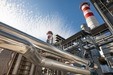
Large energy capacity is also being built in the province. In recent years, $2 billion has been attracted to green energy, and 1,000 megawatts of wind power, 750 megawatts of solar power and 63 megawatts of energy storage have been commissioned. A 601-kilometer trunk power line has been laid.
Construction continues on the 300-megawatt Bosh-2 wind farm in Gijduvan with ACWA, and on wind farms with a combined capacity of 1,000 megawatts in Jondor with Toyota Corporation and in Peshku with Sinoma. Plans call for a $165 million project with Chinese partners in Kogon district to generate electricity from household waste, and a $150 million project with Germany’s Leman to ensure stable operation of the pumping stations on the Amu-Bukhara canal.
Drawing on the province’s cotton-growing experience, modern textile clusters are being developed. A textile complex under the Kurt Bauer brand, producing 62,000 tons a year, will be built in Bukhara city. A $400 million cotton-textile cluster with Chinese investors is being set up in Romitan. An initiative to bring 9,000 hectares of land into use has also been put forward under these projects. The aim is to raise the share of high-value-added products to 65% and create an additional $100 million in export potential.