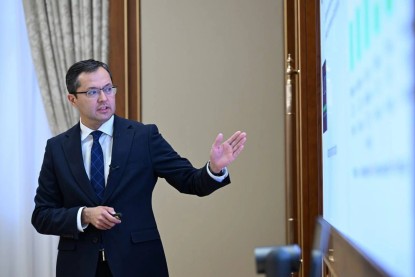
Uzbekistan's financial sector is planned to be brought into compliance with all 29 core principles of effective banking supervision of the Basel Committee by 2026, the presidential press service said following a presentation made to the president on Thursday.
During the presentation, Shavkat Mirziyoyev underscored that over the past seven years, the assets of commercial banks in Uzbekistan had grown 5.3-fold, exceeding 877 trillion soums. The number of banks in the country has reached 35, with three foreign banks entering the market since 2017.
For the first time Uzbekistan participated in the Financial Sector Assessment Program (FSAP), conducted by the International Monetary Fund and the World Bank. The assessment covered key areas of the financial system, including banking supervision, risk management, payment system performance, macroprudential policy, and crisis response mechanisms.
Following the assessment, Uzbekistan's financial sector is planned to be brought into compliance with Basel Committee standards by 2026.
To achieve this, the objectives include the full transition of commercial banks to International Financial Reporting Standards (IFRS), the implementation of Basel III requirements, and the establishment of a Financial Stability Council with the participation of the government and the Central Bank.
Financial Sector Assessment
As part of the Financial Sector Assessment Program (FSAP), the IMF prepared a detailed report on Uzbekistan's compliance with the Basel Core Principles for Effective Banking Supervision. The document is based on data as of May 2025.
Uzbekistan's banking regulatory and supervisory system is rated "compliant" with four principles and "significantly compliant" with 16 principles of the Basel Committee's 29 core principles for effective banking supervision. Nine principles are "significantly non-compliant."
IMF experts underscored that in recent years, the Central Bank of Uzbekistan had strengthened regulation and supervision, including introducing elements of a risk-based approach and updating several regulations. However, the supervisory system remains deficiencies in a number of principles.
According to the IMF, the Central Bank's de jure independence is enshrined in the Constitution and the Law on the Central Bank, but in practice it is limited. Other bodies influence the formation of prudential policy: some regulations require approval by the Chamber of Commerce and Industry, and the Ministry of Justice can refuse to register documents not only for technical reasons but also for other reasons. Furthermore, the Central Bank is tasked with implementing development programs, which, according to experts, reduces its operational independence.
They also underscored that the Banking Law failed to explicitly grant the Central Bank the authority to analyze the activities of parent companies and affiliates of banking groups to assess their impact on a bank's stability. Consolidated supervision has not yet been implemented: requirements are applied primarily at the level of individual banks, and regulations on the supervision of banking groups remain under development.
The IMF also underscored gaps in corporate governance and risk management. The Central Bank has no formal requirements for banks' crisis recovery plans, and the requirements it has introduced for internal capital adequacy assessment procedures are optional.
Regarding credit risk, experts point to the persistent share of mortgage loans to households without official income and signs of overheating in the housing market, as well as the rapid growth of auto loans.
Reporting issues are also identified as vulnerabilities. Prudential reporting is collected on an individual, rather than consolidated, basis and is based on internal accounting rules, not fully on international standards. The Central Bank does not collect data to assess the significance of financial risks associated with climate change, and all banks, regardless of size or business model, are required to submit the same volumes of information.
Experts underscored that the announced transition to Basel III standards had not been fully implemented: the definition of capital and the calculation of risk-weighted assets differ from the Basel methodology. In particular, some capital instruments do not provide for a write-off or conversion mechanism upon the occurrence of trigger events, and certain asset types are weighted with reduced risk compared to international approaches.
Other concerns include the insufficient formalization of the role of bank supervisors (a supervisor is not a member of the bank, but may attend board meetings of a commercial bank as an observer), the lack of a systemic mechanism for monitoring compliance with regulations, a narrow definition of problem assets, and poor coverage of transactions with related parties, including state-owned enterprises, in state-owned banks.
Recommendations
Among the key proposals is strengthening the independence of the Central Bank. IMF experts recommend removing provisions under which the Central Bank's participation in the implementation of government development programs could undermine its operational independence, as well as limiting the ability of other bodies to influence the adoption of prudential regulations. Specifically, they propose eliminating the requirement for the approval of CBU regulations by the Chamber of Commerce and Industry and narrowing the grounds for refusing their registration by the Ministry of Justice.
A separate set of recommendations concerns governance within the Central Bank itself. The IMF proposes enshrining in law criteria for the professional suitability and impeccable reputation of board members, introducing requirements for independent members (including prohibiting them from holding the same position as a member of parliament or government), and mandating the publication of reasons for the dismissal of the Central Bank governor.
It also recommended regularly and publicly summarizing the progress of the banking sector reform strategy and updating supervisory priorities.
The Fund urges accelerating the implementation of consolidated supervision. The Central Bank recommends defining the perimeters of banking groups, implementing consolidated reporting, establishing prudential requirements at the group level, and assessing the risks emanating from parent and affiliated entities.
To this end, it has also proposed to expand the CBU's authority to request information from any company within a group.
Experts point to the need to formalize the role of bank supervisors (what they can and cannot do), introduce a "cooling-off period" before their possible hiring by banks, and strengthen off-site and on-site supervision of corporate governance. It is proposed to require banks to notify the regulator of all material changes in their operations and extend the duration of on-site inspections to 60-90 days.
The IMF advised revising the approach to reporting and capital: collecting data on a consolidated basis, relying on international accounting standards, and implementing the full set of Basel III instruments, including adjusting capital requirements based on the risk profile (Pillar 2) and establishing capital buffers for systemically important banks. It is also proposed to align the methodology for calculating risk-weighted assets with Basel standards.
Separate recommendations were made for credit and non-performing assets. The Central Bank is urged to tighten supervision of mortgage lending (especially for borrowers without verified income), revise its approach to additional lending for existing "standard" loans, expand the definition of non-performing loans and assets with revised terms, and introduce stricter criteria for transferring loans from the non-performing to performing category.
The IMF considers the reviewing climate and sovereign risks an important area. The regulator is recommended to integrate climate risks into the risk-based supervision system, conduct an analysis of banks' sensitivity to these risks, and collect relevant reports. It is also recommended to systematically monitor the concentration of investments in government debt and take into account the results of stress tests when assessing bank resilience.
The IMF also emphasized the need to update market, interest rate, liquidity, and operational risk requirements, develop comprehensive stress testing scenarios, strengthen outsourcing and internal audit regulations, and, for state-owned banks, expand disclosure of information on transactions with state-owned enterprises.
A separate set of recommendations concerns combating money laundering and terrorist financing. Experts call for further strengthening of the human and technological capacity of supervisors in this area and the creation of specialized teams to address emerging risks, including cryptocurrency transactions and fraud.
The IMF recommendations are advisory in nature, but their implementation, as the authors of the report note, could significantly improve the resilience of Uzbekistan's banking system and bring regulatory and supervisory practices closer to international standards.