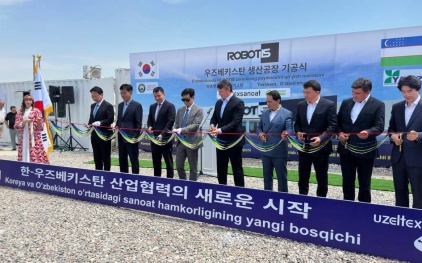
South Korean robotics manufacturer ROBOTIS is investing nearly $100 million to build a robot production plant, South Korea's ambassador, Won Do-yeon, said in an interview with Uzbekiston 24 television's "Tahlilnoma" program.
"I am confident that even more joint projects will be carried out in the future in artificial intelligence, pharmaceuticals, biotechnology, and other promising, high-tech fields," he said, discussing joint Uzbek-Korean initiatives.
Founded in 1999, ROBOTIS is one of the world's leading companies in autonomous robotics. Its technologies are widely used by global giants including Amazon, Microsoft, Apple, NASA, Google, Samsung, and BMW.
Construction began in June 2026 on a ROBOTIS plant specializing in humanoid robots and their components at the "Yangi Avlod" special industrial zone in Tashkent. The project is expected to create more than 1,000 skilled jobs and facilitate the transfer of advanced foreign technologies and expertise.
According to the ambassador, the embassy has been operating at an increasingly busy pace as more Korean companies visit the country. He pointed to the Kia plant in Jizzakh province, which is expanding its production capacity; Incheon International Airport's role as a key partner in the New Tashkent international airport project; and the launch of the Korean-built Jaloliddin Manguberdi high-speed trains. He added that investment flows into traditional sectors continue to grow as well.
The country is the only Central Asian state to have established a special strategic partnership with South Korea, and Won Do-yeon elaborated on what that relationship means for Seoul.
"The Republic of Korea has established special strategic partnerships with only four countries — not dozens — one of which is the Republic of Uzbekistan. That reflects how much importance Korea places on its ties here. What makes the Korea-Uzbekistan relationship distinctive is, above all, the trust and genuine goodwill our countries share," the ambassador said.
He noted that roughly 100,000 citizens are currently living in Korea for work or study, and the number of Koreans visiting the country has also risen significantly in recent times. The distinctive nature of the relationship, he added, stems from the complementary nature of the two economies: Korea's advanced technological development pairs with the country's abundant natural resources and large pool of young, skilled workers, giving both nations substantial potential for mutually beneficial growth.
Stay up to date with all the latest news: