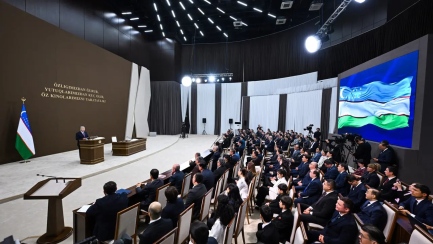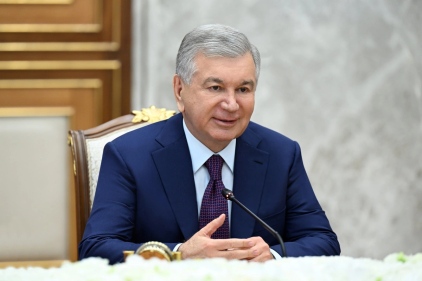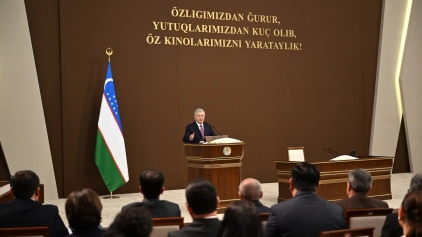
President Shavkat Mirziyoyev is meeting filmmakers at the Uzbekfilm studio. He announced a move to a new system in which the tasks of managing the film sector, financing it and making films are clearly separated.
A compact, modern management structure will be put in place. The Uzbek Cinema Agency will be abolished, and the authority to carry out national policies in the film sector will pass to the Ministry of Culture.
A Film Art Department will be created in the ministry, with its chief given a rank equal to that of a deputy minister.
Officials were directed to put the department into effective operation within a month and to ensure the dissolution of the Cinematography Agency and the organizations in its system.
Uzbekfilm’s organizational and economic model will be renewed. The state institution will be abolished, and a new national film company, Uzbekfilm, operating on a modern business model, will be created.
The president said the new company will be the core center and lead operator for building a national film brand and developing a modern film industry.
The national film company will not produce films. Film production will move entirely to the private sector. The company will select and finance projects, promote and distribute films, and take them to international markets and festivals.
This will join the whole process, from production to delivery to audiences, into a single system. Officials were instructed to launch the national film company within a week.
The president spoke about historical films made in the new era, among them “Islomkhoja,” “Ibrat,” “Avloniy,” “Abdulla Qodiriy,” “Kokand Wind,” “Muqimiy,” “Ilhaq,” “Uzbek Girl” and “Bahodir Yalangtush.”
A new generation of national talent has emerged, he said, noting that filmmakers made a worthy contribution to this.
For the first time in the history of the Golden Globe international film awards, a ceremony honoring filmmakers from Central Asia and the Caucasus was held in Tashkent. Actress Gulchehra Jamilova, who is attending the meeting, received a Meridian award.
The president also said it is necessary to speak openly about how much work remains to take national cinema to a new level.
He addressed claims that people have stopped going to cinemas because of the rise of social media, noting that audiences are packing theaters to watch foreign films.
“So viewers have not given up on cinema or on going to the movies; their tastes and demands have changed. Do our national films meet those demands? Unfortunately, no!” the president said.
The reason, he said, is that the whole chain from production to delivery to audiences, known as distribution, has not taken shape.
He said the opinions of professional film critics are not given enough weight today.
“After all, objective analysis allows a creator to see their own shortcomings and grow!” he said.
Some issues also await resolution in the current system of state commissioning and procurement for financing film projects. The old “state order” system does not meet the requirements of a modern film industry.
As many as six projects have been assigned to a single director at a time, and up to seven to a single writer. Under such a load, it is hard to work thoroughly on each piece. The fact that nearly half of the commissions went to state studios has limited equal competition for private filmmakers.
As a result, the main criterion has become closing out an assignment quickly, not creating a strong script and a quality film. Mirziyoyev said a filmmaker’s work should be judged by whether the film makes viewers think deeply and leaves a mark on their hearts.
A script can be enriched during filming and creative solutions can change, he said. For that reason, it is wrong to buy a work of art on the basis of technical specifications, like an ordinary product or a construction project.
Stay up to date with all the latest news: