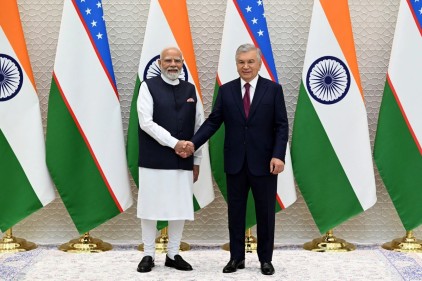
President of Uzbekistan Shavkat Mirziyoyev and Prime Minister of India Narendra Modi held one-on-one and delegation-level talks at the Kuksaroy residence on Sunday, capping a high-profile two-day state visit that both sides say marks a turning point in relations between Tashkent and New Delhi.
The visit — Modi's fourth to Uzbekistan — began with an unusually warm reception. Mirziyoyev personally welcomed Modi at Tashkent's Humo International Airport and the two leaders then rode together in the same car rather than splitting into separate motorcades, a gesture of personal diplomacy that set the tone for the talks that followed. A guard of honor was presented and the flags of both nations were displayed at the airport, underscoring the ceremonial weight Tashkent attached to the visit.
A relationship rooted in history, now formalized further
Officials from India's Ministry of External Affairs said the two leaders used the talks to reflect on the full spectrum of bilateral relations, describing them as rooted in civilizational ties built over centuries and reinforced by strong people-to-people bonds. That framing was matched by concrete outcomes: following the talks, the two countries agreed to elevate their relationship to a comprehensive strategic partnership — a significant upgrade in diplomatic status that both governments had been signaling for months.
During the visit, the two leaders reviewed cooperation across trade and investment, defense, digital connectivity, energy, education and people-to-people domains, and set the agenda for the road ahead, with plans to align their long-term development strategies — India's Viksit Bharat 2047 vision and Uzbekistan's Uzbekistan–2030 program.
Uzbekistan confers its highest honor
In a further sign of the significance Tashkent placed on the visit, Mirziyoyev conferred on Modi the Highest Degree Do'stlik Orderk, Uzbekistan's supreme state award. Modi dedicated the honor to the enduring bond between the two nations, and it stands as the 36th international award he has received.
Trade momentum builds toward a $5 billion target
The economic figures presented during the talks reflect a relationship that has accelerated sharply in recent years. Bilateral trade crossed $1 billion for the first time last year, according to official statistics — a benchmark both sides now consider a floor rather than a ceiling. The number of joint ventures operating between the two countries has grown sevenfold in recent years, and the two capitals are now connected by 14 direct flights a week, a frequency that has helped drive both commercial exchange and tourism.
Buoyed by that trajectory, the two sides agreed to take the necessary steps to push bilateral trade turnover to $5 billion by 2030 — a fivefold increase from current levels that officials described as ambitious but achievable given the pace of recent growth.
To get there, particular focus was placed on expanding industrial cooperation and launching new joint ventures. The two leaders spoke favorably of prospects for deeper partnerships with leading Indian firms across energy, electrical engineering, metallurgy, critical minerals, healthcare, pharmaceuticals, agriculture and jewelry manufacturing — sectors seen as complementary to Uzbekistan's resource base and India's industrial and technological capacity. Analysts noted that India is seeking greater access, connectivity, minerals and security cooperation, while Uzbekistan is looking for investment, technology and a deeper partnership with one of the world's largest markets.
Education, culture and the diaspora take center stage
Beyond economics, the visit highlighted a fast-growing education and cultural relationship. Four Indian universities now operate campuses in Uzbekistan, reflecting Tashkent's push to diversify its higher-education offerings and India's growing soft-power footprint in Central Asia. Officials on both sides pointed to the rising popularity of yoga in Uzbekistan as an example of expanding cultural exchange, and a five-year program on cultural cooperation is expected to be signed as part of the visit.
Modi is also expected to visit the Shastri Memorial in Tashkent and the Mahatma Gandhi Centre at the Tashkent State University of Oriental Studies, sites that hold symbolic weight in the two countries' shared history — the memorial marks the death in Tashkent of former Indian Prime Minister Lal Bahadur Shastri in 1966. Modi also engaged with members of the Indian diaspora during his stay, part of a broader effort by New Delhi to strengthen people-to-people ties across the region.
Deepening political dialogue and inter-provincial partnerships
On the diplomatic front, the two sides agreed to intensify political dialogue and exchanges at every level, including through parliamentary friendship groups, the intergovernmental commission and the joint business council — mechanisms designed to keep momentum going between high-level visits.
The talks also spotlighted a less-publicized but increasingly active dimension of the relationship: subnational partnerships. Close cooperation ties have already been established between Andijan province and the Indian state of Gujarat, Fergana province and Haryana, and Samarkand province and Agra — pairings that officials say allow for more targeted, practical collaboration than top-down diplomacy alone can achieve.
Broader international and regional issues were also on the agenda, reflecting the two countries' shared interest in Central Asian security and connectivity. At the close of the meeting, heads of ministries and government agencies on both sides were instructed to ensure active follow-through on the joint projects and programs agreed during the visit.
Part of a wider regional push
The Tashkent stop is the first leg of a broader Central Asia tour: Modi is scheduled to travel on to the Kyrgyz Republic to attend the 26th Shanghai Cooperation Organisation summit in Bishkek from August 31 to September 1, a gathering marking the SCO's 25th anniversary. He is also set to attend the opening ceremony of the 6th World Nomad Games in Kyrgyzstan, part of a broader engagement with the region's cultural heritage.
The visit comes as New Delhi works to build deeper influence in a region where China and Russia have long maintained extensive economic and security networks — a dynamic that gives added strategic weight to Sunday's talks and to the comprehensive strategic partnership now underpinning the Uzbekistan-India relationship going forward.