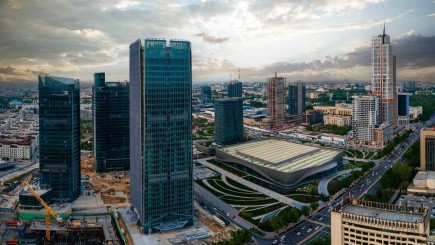
Tashkent ranked 343rd out of 1,000 major cities worldwide in the Global Cities Index 2026, compiled by the research firm Oxford Economics. Uzbekistan's capital climbed 128 places over the past year.
Oxford Economics also placed Tashkent among its "28 Cities to Watch" — a group of cities showing strong momentum and potential for significant gains in the years ahead.
"Tashkent is emerging as one of Central Asia's most promising urban economic hubs," the report says. Before the collapse of the Soviet Union, Tashkent was a major industrial center; since independence and its opening to international markets, the city's economy has diversified considerably. Today, the report notes, the Uzbek capital is posting steady growth accompanied by a construction boom and rising investment across multiple sectors of the economy. Unlike many cities in Eastern Europe and Central Asia, it also continues to see sustained population growth.
Among the city's key strengths, the index cites its geographic position and skilled workforce. At the same time, Oxford Economics warns that Tashkent's low per capita GDP raises the risk of a "brain drain" to wealthier countries. The report also flags environmental strain — particularly water scarcity — as a pressing concern requiring attention.
Tashkent's scores
The index combines five categories — economics, human capital, quality of life, environment, and governance — each scored on a 0-100 scale before being combined into an overall ranking.
In the Economics category, Tashkent scored 54.7 points, placing 188th worldwide, within the top 20%. This category measures the scale, structure, and growth trajectory of a city's economy, drawing on both historical performance and future outlook.
In Human Capital, Tashkent scored 61.5 points, ranking 108th globally, also within the top 20%. This measure assesses the size and quality of a city's talent pool, along with its ability to attract, develop, and retain skilled professionals.
In Quality of Life, Tashkent scored 47.5 points, placing 644th worldwide — in the bottom 40% of the ranking. This category evaluates residents' wellbeing and satisfaction, along with living conditions such as household finances, health outcomes, and access to urban infrastructure.
In Environment, Tashkent scored 45.1 points, ranking 806th globally, within the bottom 15%. This measure captures how well a city balances development with environmental stewardship, as well as its exposure to environmental risk.
Tashkent posted its lowest score in Governance — 40.2 points, placing 825th worldwide, within the bottom 15%. This category reflects the strength of a city's institutions, the quality of its regulatory environment, and the stability of conditions for residents and businesses. "Effective governance underpins a city's ability to plan, invest, and meet the needs of residents and businesses," the report's authors note.
Top 10 cities
The ranking's top spots are dominated by cities in the United States, Europe, and Asia. New York topped the list with a perfect 100 points, followed by London at 98.8; both cities scored highly for the scale of their economies and human capital. Paris placed third with 93.4 points.
Rounding out the top 10 were Seattle, San Francisco, Dublin, Boston, San Jose, Tokyo, and Zurich.
Among Central Asian cities, Almaty ranked 265th and Astana 281st, while Bishkek placed 461st, Ashgabat 668th, and Dushanbe 672nd.