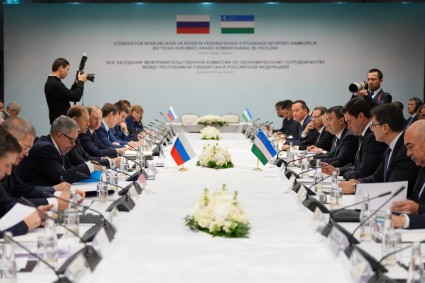
The 26th meeting of the Uzbek-Russian Intergovernmental Commission (IGC) on Economic Cooperation took place in Tashkent on Wednesday.
In the meeting, chaired by Deputy Prime Ministers Jamshid Khodjaev and Russian Deputy Prime Minister Denis Manturov, were also present ministers and governors of Tashkent, Fergana, Kashkadarya, and Surkhandarya provinces, as well as Nizhny Novgorod and Omsk provinces, Bashkortostan, and Krasnoyarsk Krai.
In 2024, the trade between the two countries surpassed $11 billion, almost double the level of six years ago, said Deputy PM Khodjaev. "While, we are expecting a rise to $12 billion in the end of this year," he said.
Uzbekistan's exports from January to October valued at $3.6 billion. Russia has consistently ranked second among Uzbekistan's trade partners on 16% of Uzbekistan’s trade. "Uzbekistan is also among Russia's top ten largest trading partners. This demonstrates the reciprocal, rather than one-sided, nature of our economic cooperation," said Khodjaev.
The parties have set a trade target of $30 billion by 2030. To support this target, the countries are actively implementing mutual settlements in their national currencies, which already account for over 75% of the total volume.
Jamshid Khodjaev called this figure a "significant step" and underscored that "it needs to be reinforced by the development of payment channels, system integration, and improved cybersecurity and compliance."
"Amid geopolitical turbulence, Denis Valentinovich [Manturov] and I are constantly putting this on the agenda: the stability of the payment infrastructure and digital services is becoming a key issue," the Deputy PM Khodjaev added.
Denis Manturov underscored that "Russian e-commerce platforms were making a significant contribution to the development of trade and economic cooperation." Last year, the volume of Uzbek-made goods sold on the Wildberries platform topped USD 605 million. "Our marketplace has thus become the largest distribution network for Uzbek goods. The company plans to build the largest logistics center in the country, covering 100,000 square meters, with investment estimated at over 11 billion rubles, and the number of new jobs nearly 7,500. The phased commissioning of the warehouse complex is due in the end of next year," he said.
Energy
In the energy sector cooperation, Jamshid Khodjaev underscored that Russia has increased oil exports to Uzbekistan, with a gas sales contract in effect."
Denis Manturov, in turn, reported on the development of the dialogue on Russian energy exports to Uzbekistan.
The parties did not outline specific parameters, likely due to the sanctions pressure on the Russian oil and gas sector, which makes publicity a sensitive factor.
Reportedly, the continued energy-related dialogue within the IGC testifies to the long-term nature of the bilateral cooperation. The nuclear power plant project in the Jizzakh province, which the parties call a "flagship" project in the energy sector, remains an important factor.
Investments and Localization
Investment and localization were discussed more openly at the meeting. Russian business remains one of the most heavily present in Uzbekistan, with over 3,000 Russian-invested companies. This figure remains high despite a slowdown in recent years, amid the increasing presence of Chinese investors.
"The total portfolio of joint investment projects with Russia has surpassed $55 billion. In 2025 alone, we expect to disburse approximately $5 billion in Russian investment," said Jamshid Khodjaev. He estimates this to be a significant foundation, "which should yield tangible returns in the form of new production facilities, jobs, and tax revenues."
The two countries are cooperating within the framework of a joint investment platform, agreed upon in May 2024 during Russian President Vladimir Putin's visit to Uzbekistan. Denis Manturov stated: "Today, we agreed to implement a number of amendments that will serve to expand the capabilities of this instrument." In particular, a pilot project to expand soft drink production unit in the Tashkent province is being prepared to be launched, with the value of investment of over 3 billion rubles.
Joint industrial parks in Chirchik and Jizzakh, and planned ones in Navoi and Bukhara, have been identified as key hubs for industrial cooperation.
"It is important that further growth in bilateral trade to be driven by deeper processing and cooperation. We believe it would be appropriate to focus on developing joint value chains in mechanical engineering, chemicals, construction, pharmaceuticals, food, and light industry," noted Jamshid Khodjaev.
The Deputy Prime Minister proposed tasking the two countries' agencies with expediting the creation of joint industrial engineering centers. "We propose, Denis Valentinovich, giving directives to our agencies to consider how we can implement a project for an engineering center specifically with the Russian Federation. And if our colleagues support this, this will be a new challenge for us," he said.
Cooperation Between Provinces
Cooperation between provinces was particularly warmly discussed. Around 80 Russian provinces have established direct contact with provinces of Uzbekistan. The Council of Provinces, established in 2024, held two meetings—in Tashkent and the Moscow Province.
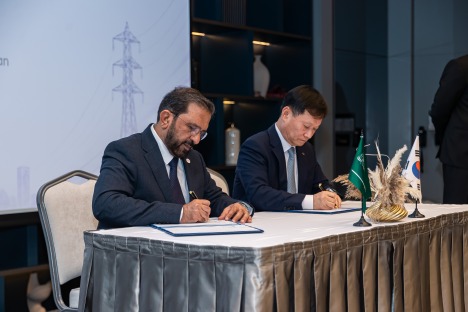
Following the IGC meeting, a roadmap for strengthening interprovinceal cooperation for 2025–2030 was signed. Furthermore, an action plan for trade and economic cooperation between Uzbekistan and Bashkortostan for 2025–2026 was signed, as well as a memorandum of understanding between the SME Corporation and the Agency for the Development of Light Industry of Uzbekistan.
That evening, the Russian delegation—Denis Manturov, the heads of four Russian provinces, and the heads of several companies—was received by Uzbek President Shavkat Mirziyoyev. The results of the IGC meeting were described as fruitful. Russian businessmen presented projects to the president in the fields of IT, energy, electrical engineering, mechanical engineering, chemicals, pharmaceuticals, textiles, and food processing.