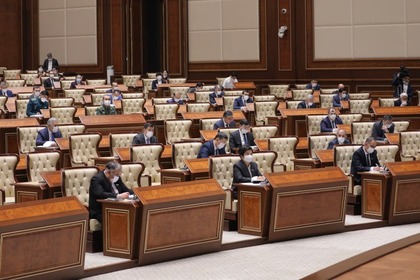
At its December 18 meeting, the Senate passed the Uzbekistan 2026 State Budget Bill and the Main Axes Of 2026 Fiscal Policies Bill.
The Deputy PM/Minister of Economy and Finance Jamshid Kuchkarov delivered a report, presenting the main macroeconomic forecasts, budget parameters, and changes to fiscal policies.
Macroeconomic Forecasts
The following is forecast in 2026:
- GDP growth -6.6%;
- GDP per capita - at over $4,000;
- Inflation - below 7%.
Consolidated budget revenues are projected at 515.8 trillion soums, expenditures at 567.0 trillion soums, and a fiscal deficit of approximately 60 trillion soums (3% of GDP).
Market services are expected to grow by 14.5%, industrial production - by 6.4%, construction - by 10.2%, and agriculture - by 4.2%. Economic growth will also be supported by a 13.1% increase in the loan portfolio, an 8.1% increase in fixed capital investment, and a 15.1% increase in exports excluding gold.
The minister added that in 2025, Fitch and Standard & Poor's rating agencies upgraded Uzbekistan's sovereign rating, which, he said, will contribute to the country's investment attractiveness and reduce the cost of borrowing.
The maximum borrowing limits for 2026 are:
- $2.5 billion for financing the state budget deficit;
- $2.5 billion for investment projects.
The maximum net government securities value will be 30 trillion soums, and the maximum value of new public-private partnership projects will be $6.5 billion.
Tax Policy
According to Jamshid Kuchkarov, the main tax rates will remain the same in 2026 to ensure stability and predictability. Specifically, the following will remain at the same rates:
- Profit tax — 15%;
- Personal income tax — 12%;
- VAT — 12%;
- Social tax — 12% (25% for budgetary organizations);
- Turnover tax — 4%;
- Corporate property tax — 1.5%.
A number of steps to support businesses will take effect starting January 1, 2026. Companies transitioning from turnover tax to VAT and profit tax for the first time will be waived from paying profit tax for one year. Their accounting expenses for six months can be taken into account when calculating the taxable base.
For sole entrepreneurs and self-employed individuals with a turnover of up to 1 billion soums, the turnover tax rate will be reduced to 1%, while the flat income tax for sole entrepreneurs and the tax exemption for the self-employed with incomes of up to 100 million soums will be lifted.
A zero VAT rate will be introduced for agricultural manufacturers, and any negative VAT refunds will be processed automatically within three days.
Considering WTO requirements, it is planned to equalize excise tax rates on imported and domestic products starting July 1, 2026. Specifically:
- alcoholic beverages – 48,000 soums per liter;
- natural wine – 10,000 soums, other wines – 12,000 soums per liter;
- beer – 4,000 soums per liter.
Starting April 1, 2026, a progressive excise tax on sugary drinks will be introduced, depending on their sugar content, as well as an excise tax of 15,000 soums per kilogram of potato chips.
More details about taxes
Budget Expenditures and Social Areas
State budget expenditures for next year will toз 402.6 trillion soums, of which 54.7% (220 trillion soums) will be contributed to the social areas.
100 trillion soums (25% of total budget expenditures) are planned for education, and 49 trillion soums for healthcare, which is 5 trillion soums more than in 2025. Sports expenditures will top 3.7 trillion soums, and culture expenditures will top 4.4 trillion soums.
Starting in 2026, maternity benefits, and starting July 1, temporary disability benefits, will be paid through the Social Insurance Fund. 3.4 trillion soums have been contributed for these purposes, including 1.5 trillion soums in budget transfers.
15 trillion soums have been contributed for the housing improvement program in 2026, including 12.3 trillion soums for mortgage lending and 2.7 trillion soums for subsidies.
Initiative-Based Budget and Provinces
Six trillion soums have been contributed for the Initiative Budget program. Of this amount, 496 billion soums are for the implementation of parliamentary initiatives, and 506 billion soums are for the implementation of projects in the form of "co-financing" partnerships between the population and the state.
Each MP of the Legislative Chamber will have the right to select one additional project per season, for which 3.3 billion soums will be contributed.
3.9 trillion soums will be contributed for developing districts, cities, and neighborhoods within the New Uzbekistan scheme, with another 1 trillion soums to be contributed for infrastructure for driver in industrial, agriculture, and services projects.
Starting in 2026, 5% of VAT revenues will go to the Tashkent city budget, and 20% to the budgets of Karakalpakstan and the provinces. This will leave 4.3 trillion soums available to local budgets. Of this amount, at least 50% must go to district and city budgets.
Local budget revenues in 2026 will top 76 trillion soums, while expenditures will total 95.6 trillion soums. The consolidated budget will end with a deficit of 3% of GDP, or 60 trillion soums.