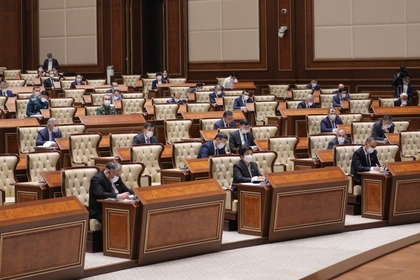
MPs in the Legislative Chamber on Nov. 17 passed the Capital Market Bill in its second and third readings and sent it to the Senate, advancing a bill that overhauls capital market regulation, strengthens investor protections and deploys new financial instruments.
The bill also aims to integrate the stock market of Uzbekistan with international markets.
Jamol Ochilov, deputy chairman of the Committee on Budget and Economic Issues, said more than 40 working-group sessions with international financial organizations, experts and market representatives were held before the second reading. Some regulator powers were revised, guarantees for businesses and investors were strengthened, and rules on issuing financial instruments were clarified, he said.
Among the changes, a provision letting the National Agency for Prospective Projects (NAPP) suspend licenses for more than 10 days without a court ruling was removed, Ochilov said. Refusals to register securities issues must now be justified instead of resting on the regulator’s professional judgment. The bill also lowers the ceiling on registration fees and restores paper issuance for non-issue securities.
The bill gives the NAPP expanded supervisory functions. The October version allowed it to impose financial sanctions itself, up to 2% of charter capital for professional participants and 0.5% for issuers. The final limits were not discussed on Nov. 17, and whether they remain must be checked against the final text.
The bill creates a legal framework for derivatives, including options, futures, forwards, swaps and contracts for difference, as well as covered, securitized and sustainability bonds. The NAPP expects the new instruments to attract an additional 10 trillion soums of investment to the stock market by 2030.
Investors will be divided into qualified and unqualified categories, and unqualified investors will be able to use professional trust managers to access some complex instruments. Custodian activity becomes a separate licensed activity, and a central counterparty will be established.
“We must not limit ourselves to what has been achieved,” Saulat Toreshov, head of the NAPP’s capital market regulation department, said at an Oct. 14 press conference. “That is why the Capital Market Law was drafted.”
The agency says the market has grown quickly. Share issuance rose from 189.7 trillion soums in 2023 to 265.1 trillion soums in 2025, while exchange trading volume climbed from 2.9 trillion to 17.6 trillion soums.
NAPP representatives said the bill is a framework law, with detailed requirements to be set in the regulator’s regulations. The special regime known as the regulatory sandbox will remain in place.
The bill originally had 246 articles. By October it had 16 chapters and 123 articles.
The securities market is currently governed by the Securities Market Law, adopted in 2008 and reissued in a new version in 2015. The new law takes effect only after Senate approval and the president’s signature.
Stay up to date with all the latest news: