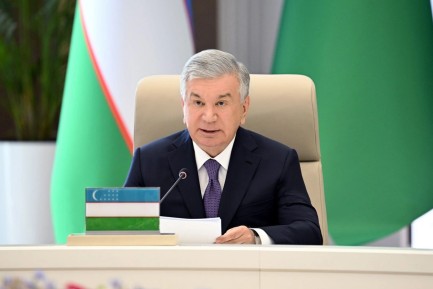
President Shavkat Mirziyoyev took part on July 31 in an informal meeting of Central Asian and Azerbaijani heads of state, held in Cholpon-Ata, Kyrgyzstan.
The gathering brought together Azerbaijani President Ilham Aliyev, Kazakh President Kassym-Jomart Tokayev, Kyrgyz President Sadyr Japarov, Tajik President Emomali Rahmon, and Turkmen President Serdar Berdimuhamedov.
Opening his remarks, Mirziyoyev noted that the meeting was taking place ahead of celebrations marking the 35th anniversary of independence for the countries of the region. "Over these years, each country has followed its own unique and unrepeatable path of state-building, economic growth, and national revival. Thanks to our joint efforts, a once-fragmented Central Asia is now consolidating around shared development goals," the president said.
At the same time, he said, "a complex and unpredictable international landscape" demands "decisive action and closer coordination" from the region. Azerbaijan's inclusion in the consultative meeting format, he added, elevates cooperation between the countries to a new, macro-regional level.
"We now have a historic opportunity to build a unified space for development that brings together Central Asia, the South Caucasus, and our close neighbor, Afghanistan," the Uzbek leader said.
"The time has come to move toward building a sustainable architecture for regional cooperation," Mirziyoyev added. Such a framework, he said, should rest on effective cooperation institutions, close contacts between sectoral agencies, direct ties between regions, and long-term joint programs in key areas of development.
He stressed that strengthening the region's standing on the international stage requires greater coordination within interstate organizations and "Central Asia Plus" formats.
"Further steps to strengthen trade, economic, and transport connectivity, to build out end-to-end industrial and technological supply chains, to develop shared digital services, and to launch investment platforms all call for detailed, substantive work," the president said.
"Central Asia should become a competitive hub for education, science, and innovation in big data. That can be achieved by building an integrated infrastructure that brings together human capital, artificial intelligence technologies, data centers, and energy capacity," the Uzbek leader said.
The president noted that environmental protection remains a priority on the regional agenda, since emerging natural challenges "do not recognize state borders" — meaning the response to them must be collective as well.
"This summer's extreme heat has once again shown that climate change is already a factor directly affecting the economy, water and energy security, public health, and quality of life. It's essential that we find long-term solutions for adapting to these new risks together," Mirziyoyev said.
The Uzbek leader also noted that the humanitarian dimension remains an enduring priority of regional cooperation.
"Our peoples have lived side by side for centuries, building trade ties and exchanging knowledge and cultural traditions. While preserving the distinct national identity of each of our peoples, a broader shared regional identity is gradually taking shape," the president said. He expressed confidence that a qualitative renewal of work in this area would strengthen "a sense of unity, solidarity, and mutual understanding" among the region's peoples.
Stay up to date with all the latest news: