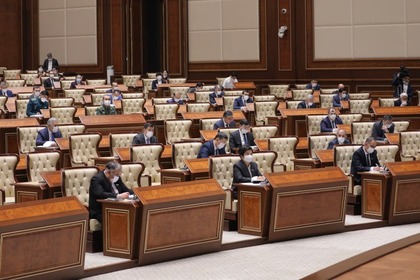
The Senate passed a bill at its August 8 session aimed at strengthening guarantees of freedom of entrepreneurial activity and improving mechanisms to support business.
The legislation amends a number of existing bills and enshrines, at the statutory level, additional guarantees for entrepreneurs, forms of state support, rules governing the application of financial penalties, inspection requirements, and protections for property rights.
The bill on guarantees of freedom of entrepreneurial activity is set to include a new article laying out the core principles underpinning these guarantees. Among them: legality, freedom of enterprise, equality among business entities, protection of legitimate trust, a prohibition on corruption, the inviolability of private property, and stability and clarity in legislation.
At the same time, the bill refines how businesses are classified by annual revenue. Microenterprises will be defined as businesses founded by individuals with annual revenue up to 1 billion soums; small enterprises will be those with revenue between 1 billion and 10 billion soums. Medium-sized businesses will be defined as those earning between 10 billion and 100 billion soums annually, and large businesses as those earning more than 100 billion soums.
50% of the fine, or a six-month installment plan
One change concerns how businesses comply with rulings by regulatory bodies imposing financial penalties. Entrepreneurs will be able to voluntarily settle such a ruling in one of two ways.
If a business pays 50% of the fine within one month of receiving the ruling, the remaining half will be waived. Alternatively, it can request a six-month installment plan with equal payments, provided it makes an initial payment of at least one-sixth of the fine within the first month.
"The installment procedure for paying fines will apply automatically — no separate application will be required," said Senator Erkin Gadoyev.
The bill also stipulates that holding a business entity financially liable for violating the bill should not automatically serve as grounds for holding one of its employees administratively liable.
Only items listed in the registry can be enforced
Another section of the bill concerns the Unified Registry of Mandatory Requirements for business. It will function as an open database listing all requirements imposed on businesses, including how long each requirement remains in force, the documents needed to demonstrate compliance, the rules governing state oversight, and the penalties for violations.
A representative of the Ministry of Justice told the Senate that around 42,000 mandatory requirements have already been entered into the registry. The bill also establishes the principle that state bodies and regulators will not be permitted to impose requirements on businesses that are not listed in the registry.
Reopening privatization deals ruled a violation of property rights
Under the bill, any move by state bodies to revisit or annul the results of a privatization will be treated as a violation of the inviolability of private property. This covers, among other things, attempts to reassess the value of privatized assets or challenge the results of valuations and appraisal reports.
State bodies, regulators, bill enforcement agencies and courts will be barred from initiating a review, invalidation or annulment of such results, and, under the bill, such cases should not be accepted for consideration at all.
"If property was privatized in the past, the bill makes clear that the results cannot be revisited and the property cannot be reappraised. Otherwise, liability will apply... This serves to guarantee the inviolability of property," said Senator Erkin Gadoyev.
When regulators can halt a business's operations
The bill also sets out the grounds on which a business's operations may be suspended. A business will be able to voluntarily halt operations on its own initiative. In addition, regulatory bodies will be able to suspend operations for up to 10 working days, with any longer suspension requiring a court order.
Regulators will only be permitted to halt a business's operations where circumstances match those listed in a dedicated registry of factors posing a high risk to life and health; in all other cases, regulators will not have the authority to suspend business activity.
indemnity for land seizure
The bill separately enshrines entrepreneurs' rights to land, water — within established quotas and limits — and connection to energy sources. Energy suppliers will be required to meet businesses' energy needs safely, reliably, steadily and without interruption.
Seizure of a business's land plot for public needs will be permitted only after full compensation for losses, as defined by bill. Compensation must cover the market value of any buildings on the site, the market value of the land-use rights, the value of perennial plantings, relocation costs and the cost of temporary leasing of another site, lost income from use of the land and property, and other costs and losses provided for by bill or agreement.
Senate officials said the bill is intended to strengthen guarantees of entrepreneurs' rights and more clearly define the legal basis for state support to business.
Social entrepreneurship
The bill also formally defines the concept of social entrepreneurship — business activity aimed at solving social and environmental problems or mitigating their effects.
A Ministry of Justice representative told the session the provision would allow the private sector's capabilities to be used more actively in addressing social problems. "Social entrepreneurship combines social goals with business and market mechanisms, and should contribute to a sustainable, economically efficient approach to solving social problems," he said.
He noted that similar mechanisms are regulated in other countries as well — South Korea, for instance, has a dedicated bill on developing social entrepreneurship, while Kazakhstan has enshrined corresponding provisions in its Entrepreneurial Code.
The bill provides for six main forms of state support for social entrepreneurship. More broadly, mechanisms to support business include financial and in-kind assistance, subsidies, grant funding, preferential loans, and tax and other payment relief. The bill separately specifies that measures of financial and in-kind support must not conflict with World Trade Organization requirements.
Stay up to date with all the latest news: