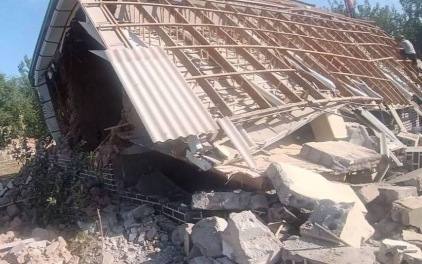
The demolition of a house and outbuildings illegally constructed on irrigated agricultural land in the Denov district of Surkhandarya province has sparked widespread discussion on social media. The Supreme Court's press service issued a statement explaining the reasoning behind the court's decision.
On August 8, reports began circulating on social media that officers from the Compulsory Enforcement Bureau were demolishing a resident's home in Denov without warning. According to the bureau, the property was demolished under a writ of execution issued by the Denov Intercity Civil Court on December 29, 2025.
According to the court ruling, a 0.20-hectare portion of irrigated farmland belonging to the enterprise Rahmon Taraqqiyot Omad Chorvachilik Bogdorchilik, located in the Chuqurqishloq neighborhood of the Galaba residential area in Denov district, had been illegally seized. The ruling ordered the demolition of the house and outbuildings constructed on the site and the restoration of the land to its original condition.
According to the Supreme Court's press service, the land was illegally occupied by Abdusalom Ahmadov and Nasiba Chariyeva, who built a house and outbuildings on it.
Why was the house demolished?
The Supreme Court stressed that the central issue in the case was the fact that the land in question was irrigated agricultural land.
Under Uzbek law, irrigated agricultural land cannot be transferred into citizens' private ownership. A law dated August 5, 2024, on recognizing rights to illegally occupied land plots and structures built on them, likewise sets out restrictions on such land.
The Supreme Court's statement noted that irrigated land is essential to the country's food security. It also noted that the land in question formally belonged to the Rahmon Taraqqiyot Omad enterprise, meaning the illegal seizure infringed not only on state interests but also on the rights of the enterprise that held the lawful right to use it.
Repeatedly warned before construction began
According to the Supreme Court, before and during construction on the seized land, the defendants were warned multiple times by responsible authorities, including the cadastre agency, the local mahalla committee and the land management service.
The court ruling noted that the demolition order was not imposed the moment the violation was discovered — other measures to resolve the violation were attempted first. Demolition, a strict measure, was applied only after those other steps failed to produce results and it was established that the land was irrigated farmland whose designated use could not be changed.
Woman faces criminal liability for illegal land seizure
According to the Supreme Court's press service, Nasiba Chariyeva was also held criminally liable for illegally seizing the irrigated plot.
The court's ruling took effect, but on March 13, 2026, an appellate body temporarily suspended its enforcement on humanitarian grounds. The Supreme Court's statement noted that the defendant was given close to two years to voluntarily remedy the consequences of the violation.
After that period passed, enforcement of the court order resumed. According to the Compulsory Enforcement Bureau, the illegal structures were demolished on August 7, fully carrying out the court's ruling.
Family to receive a new home
Following the incident, Surkhandarya provincial governor Ulugbek Qosimov met with the couple whose home had been demolished. Officials announced that a new home would be built for the family to ensure their housing needs were not overlooked and their interests were protected.
The Supreme Court warned citizens of the legal consequences of illegally seizing irrigated land and constructing buildings on it.