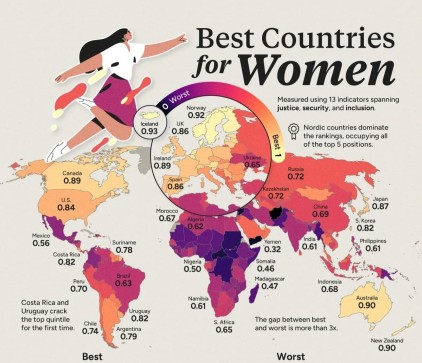
The 2025–2026 Women, Peace, and Security Index, compiled by the Georgetown Institute for Women, Peace and Security and the Oslo Peace Research Institute, assesses 181 countries and economies on women's well-being. The index scores nations on a scale from 0 to 1, where higher scores reflect superior conditions for women.
Uzbekistan ranks 98th out of 181 countries with a score of 0.674. In terms of education, women over the age of 25 complete an average of 11.8 years of schooling, while the employment rate for women aged 25 to 64 stands at 44.7 percent.
Financial inclusion remains low, with only 38.8 percent of women utilizing financial services. However, mobile phone penetration among women reaches 77 percent. In the political sphere, women hold 34 percent of parliamentary seats.
Looking at legal frameworks, Uzbekistan scored 82.5 for anti-discrimination legislation protecting women, while its performance regarding access to justice and legal recourse was rated at 1.8 points.
In the safety dimension, 11.2 percent of women reported experiencing intimate partner violence. Meanwhile, public perception of safety remains high, with 81 percent of women stating they feel safe walking alone at night in their neighborhoods.
What is the situation in Central Asia?
Central Asian nations occupy the middle tier of the index. Among the five regional countries, Kazakhstan scored the highest, while Uzbekistan recorded the lowest result.
- 72nd — Kazakhstan (0.722);
- 74th — Turkmenistan (0.720);
- 84th — Kyrgyzstan (0.697);
- 89th — Tajikistan (0.685);
- 98th — Uzbekistan (0.674).
The study evaluates 13 key indicators grouped into three primary dimensions:
- Inclusion: Women’s participation in education, employment, financial services, communications, and political life.
- Justice: Legal protections for women and their access to the judicial system.
- Security: Intimate partner violence, perceptions of community safety, political violence targeted at women, and proximity to armed conflict.
Top-performing nations: Northern Europe leads the way
Denmark once again claims the top spot globally as the best country for women. Scoring 0.939, Denmark ranks first among the 181 nations surveyed.
Northern European nations sweep the top five positions in the rankings:
- Denmark — 1st place, 0.939 points
- Iceland — 2nd place, 0.32 points
- Norway — 3rd place (tied), 0.924 points
- Sweden — 3rd place (tied), 0.924 points
- Finland — 5th place, 0.921 points
Rounding out the top ten are Luxembourg, Belgium, the Netherlands, Austria, and New Zealand, meaning advanced economies fully dominate the upper tier of the index.
The strong performance of these nations is driven by a comprehensive mix of factors rather than safety alone. These include robust opportunities in education and employment, financial independence, political representation, legal protections, and a general sense of security within society.
However, a high ranking does not imply that a country has resolved every challenge facing women. For instance, despite its high standing on the WPS Index, Finland lags behind several other developed countries in specific safety metrics. This underscores the index's core value: it evaluates a nation simultaneously across 13 distinct indicators rather than relying on a single, isolated metric.
The lowest-ranked nations in the 2025–2026 WPS Index are:
- 181st — Afghanistan (0.279)
- 180th — Yemen (0.323)
- 179th — Central African Republic (0.362)
- 178th — Syria (0.364)
- 177th — Sudan (0.397)
- 176th — Haiti (0.399)
- 175th — Democratic Republic of the Congo (0.405)
- 174th — Burundi (0.407)
- 173rd — South Sudan (0.411)
- 172nd — Myanmar (0.442)
Afghanistan consistently ranks at the bottom of this index. In the 2025/26 report, the country scored a meager 0.279. By comparison, top-ranked Denmark posted a score of 0.939, illustrating a massive global divide. The authors of the report point out that Denmark's score is more than three times higher than Afghanistan's.
The grim situation in the bottom ten countries is fueled by protracted armed conflict, political instability, severe barriers to education and employment for women, weak legal protections, and a high risk of violence.
Stay up to date with all the latest news: