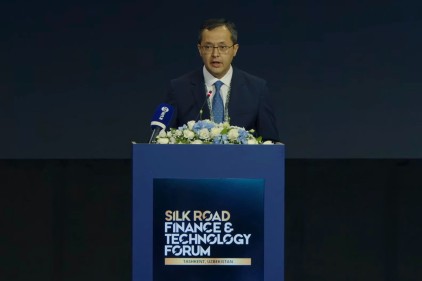
The Central Bank has announced the launch of an Innovation Hub and a dedicated venture fund, and plans to release a discussion paper on a central bank digital currency (CBDC). Central Bank Governor Timur Ishmetov made the announcement today at the opening of the Silk Road Finance & Technology Forum in Tashkent.
According to Ishmetov, authorities aim to attract $1 billion in foreign investment to the fintech sector and train 5,000 young specialists by 2030. Cashless transactions currently account for 57% of all payments in the country, while the share of women holding bank accounts has risen from 39% to 61%.
The central bank chief said Uzbekistan is positioning itself as a hub for financial technology development in Central Asia, inviting international companies to invest, pilot solutions, and build projects in the country.
"Uzbekistan is open to investment, technology, expertise and long-term partnership. Regional financial connectivity cannot be built by one country alone," Ishmetov said. "We invite our partners to work with us on the infrastructure and standards that can link the markets of Central Asia with those of other regions."
"Build here, test new solutions here, invest here, develop talent here," he added. "With the right partnerships, Central Asia can become a more connected, competitive region, better integrated into the global financial system."
Ishmetov named Uzbekistan's National Fintech Development Strategy for 2026-2030 as the first of the new initiatives.
"We are implementing Uzbekistan's National Fintech Development Strategy for 2026-2030," he said. "It brings the sector's growth under a single national policy, with an emphasis on innovation, proportionate regulation, modern financial infrastructure, access to talent and capital, and positioning Uzbekistan as a fintech hub for Central Asia."
He added that the regulator is also refining its regulatory sandbox to create clearer conditions for testing new financial products, including solutions from international companies.
Innovation Hub and venture fund
The Central Bank has also established its own Innovation Hub, with the first cohort of residents expected to be admitted in the fourth quarter of 2026.
"The hub will provide a complete pathway — from incubation and acceleration to regulatory support, pilot testing and market-readiness preparation," Ishmetov said.
A specialized venture fund has been established alongside the hub.
"We are currently in talks with experienced international fund managers, while also building a direct pipeline connecting the Innovation Hub to international market entry for its projects," the governor said. "The goal is to enable larger investment rounds and attract international co-investors."
UzQR, open banking and AI-based credit scoring
Among five priorities for developing the fintech ecosystem, Ishmetov singled out financial infrastructure. He said the Central Bank is developing the national UzQR payment system, open banking APIs — the technical "bridges" linking different digital systems — and unified payment standards.
"We are also developing open banking APIs and payment standards that will allow the financial system to scale and interact across different jurisdictions," he said.
The goal of these reforms, according to Ishmetov, is to strengthen competition, expand consumer choice, and build a financial ecosystem in which data can be used safely and responsibly to improve services. He said the Central Bank is also developing its own AI-driven alternative credit-scoring model.
The regulator further intends to elevate its policies on payment systems, open banking, and operational resilience, noting that the basic regulatory framework, governance model, and technical architecture are already in place.
Another announcement centered on the preparation of a white paper on a central bank digital currency.
"The paper will examine potential use cases, design options, key trade-offs, and implications for the financial system," Ishmetov said, adding that its findings should pave the way for a pilot phase.
"Its conclusions should form the basis for moving to an experimental stage, to test the best approaches and assess how a digital currency could support innovation and the development of Uzbekistan's digital economy," he said.
Ishmetov stressed that the Central Bank remains in the research and development phase when it comes to digital assets and new forms of money. "Our approach will be measured and evidence-based," he said.
Workforce development is set to become a dedicated priority, with plans to train 5,000 students in financial technology by 2030. The first cohort is expected to begin studies before the end of 2026, under a program developed jointly by Singaporean universities and the Global Finance & Technology Network (GFTN), a nonprofit organization established by the Monetary Authority of Singapore.
"It will combine foundational academic training with practical fintech skills," Ishmetov said.
He noted that Uzbekistan's median age of around 29 gives the country a significant demographic advantage, but one that requires sustained investment in skills and human capital.
Cashless payments now make up 57% of all transactions in Uzbekistan, a share that continues to grow each year, Ishmetov said. "More than half of the economy is made up of small and medium-sized businesses, so expanding access to financing is receiving increasing attention. Our goal is to build a resilient financial system and support productive economic activity," he said.
The share of women with bank accounts has grown from 39% to 61%, the governor added. He said fintech development must be measured not only by transaction growth and technology adoption, but by the creation of lasting economic value and stronger competition.
"Scale alone is not enough," Ishmetov said. "The goal must be to convert technology adoption and transaction growth into sustainable economic value, competition, and broader development of the financial system."
Uzbekistan aims to bring inflation down to 5% by 2027, keep its budget deficit below 3% of GDP, and secure an investment-grade credit rating. The government also intends to complete its accession to the World Trade Organization and reduce the state's footprint in the economy, Deputy Prime Minister Jamshid Kuchkarov said earlier at the same forum.
Stay up to date with all the latest news: