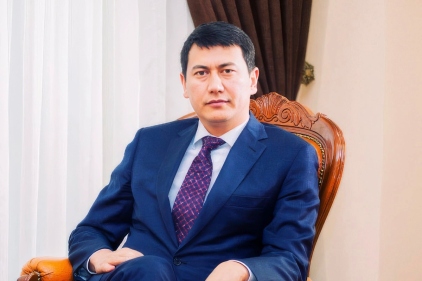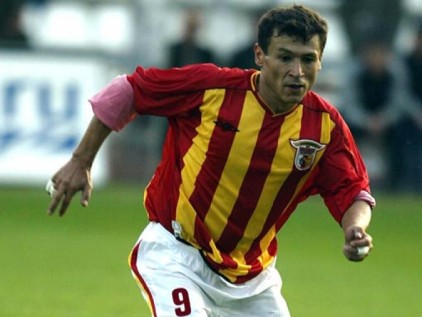
Mirjalol Qosimov, widely regarded as the greatest footballer in the country's history, celebrated his 56th birthday on Wednesday. Now head coach of Almalyk-based club OKMK, Qosimov remains one of the most decorated and respected figures in the sport's history.
Born Mirjalol Kushakovich Qosimov on September 17, 1970, in Tashkent, he began his football education at age 10 at a football school in the Chigatoy district, under coach Yuriy Gospodarchuk, who initially resisted taking him on before relenting under pressure from Qosimov and his father. He came up through the Pakhtakor Tashkent youth system before breaking into senior football.
A central midfielder standing 174 cm, Qosimov made his name as a deep-lying playmaker, operating for the national team as a creative force in midfield rather than a pure ball-winner. His game was built on vision and touch rather than power — reading play from deep, picking out teammates with disguised passes, and dictating tempo from central midfield, a style that made his free kicks, corners and long-range distribution a hallmark of his era. That quality translated into a prolific scoring record for a player in his position: he finished his career with 210 goals, enough to earn him membership of both the Club 200 of Berador Abduraimov and the Gennadi Krasnitsky club, two honors reserved for the country's most productive scorers. He also broke new ground on the European stage, becoming the first Uzbek player, and only the second Asian after South Korea's Cha Bum-kun, to score in a UEFA club competition.
His early honors came with the Soviet Union: he was part of the squad that won the 1987 FIFA U-17 World Cup in Canada and the 1988 UEFA European Under-19 Championship in Czechoslovakia, before also representing the Soviet Union at under-21 level. He went on to play for Uzbekistan from 1992 to 2005, earning 67 caps and scoring 31 goals for the national team, and helped the side win gold at the 1994 Asian Games in Hiroshima — still the country's only major international trophy — as well as reaching the final of the 1995 Afro-Asian Cup of Nations. He was voted Uzbekistan's Footballer of the Year in 1993 and 1998, and finished runner-up in 1994.
Over his club career, Qosimov turned out for Pakhtakor, Dynamo Minsk, Spartak Vladikavkaz, Alania, Krylia Sovetov, Al Shabab and Mash'al. He played a vital role in helping Mash'al finish runners-up in the 2005 Uzbek league championship, the club's best-ever result, before retiring that year. His farewell match, held on June 2, 2007, at Tashkent's MHSK Stadium, saw the national team draw 3-3 with a combined European and Asian all-star side featuring Ali Daei, Sergei Semak and Andrei Karyaka, among others.
Qosimov moved into coaching soon after retiring, first as an assistant at Mash'al and then with the national and Olympic teams under Rauf Inileev. He was named head coach of Quruvchi — now Bunyodkor — in 2007, leading the club to the semifinals of the AFC Champions League in his debut season.
He first took charge of the national team in September 2008 but was replaced in April 2010 after a difficult spell. He returned in September 2012, at times managing both Bunyodkor and the national side simultaneously, and led the team to a program-record 14 points in a single World Cup qualifying round, though it fell two goals short of reaching the 2014 tournament. He resigned after the campaign, but the Uzbekistan Football Federation declined to accept it at the time. He stepped down for good in June 2015 following a loss to North Korea in 2018 World Cup qualifying.
Qosimov returned to Bunyodkor in 2017 after a two-year hiatus, restoring the club's fortunes following a downturn during his absence, when it went without a trophy and repeatedly failed to advance past the group stage of the AFC Champions League. He left Bunyodkor again in 2018 and has led OKMK since 2019.
Career at a glance
- Full name: Mirjalol Kushakovich Qosimov
- Born: September 17, 1970, Tashkent
- Position: Midfielder / playmaker
- Clubs: FShM Moscow, Pakhtakor Tashkent, Dynamo Minsk, Spartak Vladikavkaz, Alania Vladikavkaz, Krylia Sovetov, Al-Shabab, Mash'al
- International: Uzbekistan, 1992–2005 (67 caps, 31 goals); also capped for the Soviet Union at U18 and U21 level
- Honors: FIFA U-17 World Cup winner (1987, with USSR); UEFA European U-19 champion (1988, with USSR); Asian Games gold medalist (1994); Uzbekistan Footballer of the Year (1993, 1998)
- Coaching: Olympic team (2006–07); Bunyodkor (2007–08, 2010–14, 2017–18); national team (2008–10, 2012–15); OKMK (2019–present)