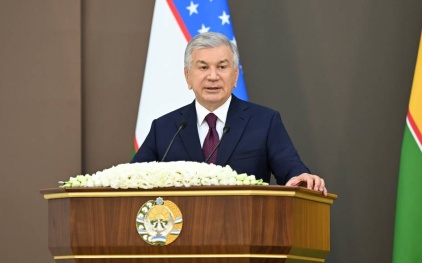
A government meeting was held as part of President Shavkat Mirziyoyev's trip to Karakalpakstan, where it was noted that irrigating 417,000 hectares of cropland in the republic takes 5.7 billion cubic meters of water, of which 38%, or 2.1 billion cubic meters, is lost, the presidential press service said.
Of the 115 million cubic meters of water that flows through the Yonbosh canal in Turtkul each year, 44 million is lost. Lining the canal fully with concrete would allow water to reach another 9,000 hectares and create a fodder base for 15,000 head of cattle.
Lining 8 kilometers of the Erkindarya canal in Buzatau would add 3,000 hectares of usable land and improve water supply to 15,000 hectares. Building three water facilities and 22 artesian wells would open up another 5,000 hectares for fodder crops.
Officials were instructed to allocate a total of 135 billion soms for the work and to finish lining both canals by March 1. In Turtkul and Buzatau, fodder crops are to be planted on 17,000 hectares next year, providing income for 2,000 people.
A $4.5 million Japanese grant for modernizing water infrastructure was cited at the meeting as a positive example. Officials were told to raise such grants to $100 million next year.
Last year, 276 water pumps were replaced with energy-efficient models at a cost of 30 billion soms, saving 16 million kilowatt-hours of electricity annually. By April 1, another 59 pumps in Karakalpakstan and 200 in other provinces will be upgraded.
Karakalpakstan has 4.3 million hectares of pastureland, of which 2.5 million hectares are underused, limiting both household incomes and livestock growth.
The company Beruniy Agrostar is restoring 2,000 hectares of abandoned farmland in Kungrad, Beruniy and Chimbay for fodder production. Another 5,000 hectares will be developed next year, creating a fodder base for 14,000 head of cattle.
In Buzatau, 100 billion soms will also be allocated to prepare 7,500 hectares for fodder. Officials were instructed to submit a decision within ten days on paying a subsidy of 500,000 soms per hectare for fodder production.
More than 200 farmers, including 26 from Karakalpakstan, have been sent to Egypt to study its farming practices. In the first phase, Egyptian methods will be implemented on 20,000 hectares in Karakalpakstan.
Egyptian specialists and technologies will be brought in to boost fodder production in desert areas. A $60 million loan and an $8 million grant from the Asian Development Bank for livestock farming will go first to this project.
Stay up to date with all the latest news: