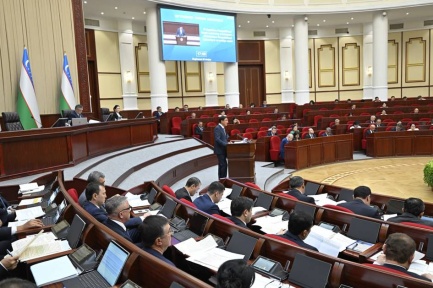
Rising inflation in Uzbekistan threatens to negate the benefits of economic growth and rising household incomes, President Shavkat Mirziyoyev warned during a meeting Friday.
"No matter how hard we work to grow the economy, if inflation continues to climb, individuals and businesses will not feel any real improvement in their lives. The rising cost of goods, labor, and services simply erodes their increased earnings," the head of state remarked.
The president noted that global oil prices have surged by 40% since the start of the year, while ongoing international conflicts have forced a shift in traditional logistics corridors. These shifts have driven up transportation costs for both local exports and essential consumer imports by 25–30%. Additionally, "imported inflation" is exerting further pressure on domestic prices, adding up to 1% to the overall rate.
However, Mirziyoyev made it clear that external factors should not be used as an excuse for inaction in the fight against rising prices.
"Every official should take note: 70% of the goods and services in the consumer basket that drive inflation are produced right here at home," he declared.
In a bid to curb rising prices, local authorities and provincial governors have been tasked with keeping inflation at 6.5% this year. The strategy focuses on boosting the domestic supply of goods and driving down production costs.
The meeting also addressed a critical shortage in the meat supply. Due to logistics disruptions, imports of cattle plummeted by half during the first quarter. To provide immediate relief, the government introduced new support measures, including subsidies of up to 4 million soums for every head of pedigree livestock imported by air and a 50% reimbursement of transportation costs for meat imports.
The President emphasized the urgent need to expand alternative transport corridors for businesses. He set a target to import 45,000 tons of meat in the second quarter, reaching a total of 130,000 tons by year-end. Officials were instructed to use real-time monitoring to resolve logistics bottlenecks proactively, rather than waiting for businesses to complain.
On the agricultural front, plans are in place to sow fodder crops across 478,000 hectares. However, progress has stalled; in the Namangan province, 74% of designated lands remain unplanted. Similar delays were noted in high-potential livestock districts like Zarbdar, Kyzyltepa, and Pop, while efforts in Amudarya, Gijduvan, Khonqa, and Bagdad were deemed unsatisfactory. Governors have been ordered to close these gaps immediately.
Furthermore, another 100,000 hectares of farmland will be auctioned under a new system, offering 49-year leases and the freedom for farmers to choose their own crops. The head of state stressed the need to accelerate this process to ensure planting remains on schedule.
Finally, entrepreneurs establishing industrial-scale plantations will receive tax breaks and financial support. Provinceal governors are expected to establish at least five major "model" fruit and vegetable plantations this year.
The potato market also drew sharp criticism. Out of the 180,000 hectares earmarked for potatoes this year, only 118,000 have been planted. In the Kashkadarya and Surkhandarya provinces, planting has reached only 41% and 44% of targets, respectively. Predictably, this shortfall has already impacted consumers: in March alone, potato prices surged by 12.4% in Surkhandarya and 9% in Kashkadarya.
Even in specialized agricultural districts—such as Khojaobad, Kasansay, and Yangikurgan—progress was deemed unacceptable. Consequently, the President ordered that provinceal deputy governors for agriculture and district leaders responsible for these delays be held strictly accountable.
Adding to the complexity, Transport Minister Ilkhom Mahkamov noted that Uzbekistan relies on nine international transit corridors. One of the most vital is the Southern Corridor through Iranian seaports, which handles a massive portion of trade, including up to 60% of cargo arriving from Turkey and Europe.
This dependence means that any escalation of conflict involving Iran would jeopardize transit. The situation is further strained by the friction between Pakistan and Afghanistan. During a January meeting between Vice Prime Minister Jamshid Khodjayev and business leaders, it was revealed that the border between those two nations has been closed since October 11, severing another critical logistics artery. These blockades are already disrupting the supply of essential goods, including sugar.