Ceremony to mark the departure of the first batch of Hyundai Rotem high-speed trains at Masan Port in Changwon, South Gyeongsang Province to Uzbekistan took place on Wednesday. The event was attended by Uzbek Deputy Prime Minister for Economic Affairs Jamshid Abdukhakimović Khojayev and other key figures from both countries' political and economic circles.
Kim Jeong-hoon, Executive Director and Head of Hyundai Rotem's Rail Solutions Division, stated, "Today's departure ceremony is not simply the departure of the trains; it is a very meaningful occasion, marking the successful entry into the global market of high-speed train technology developed domestically. We will spare no effort in providing necessary support, including maintenance and training, to ensure that all trains remain in top condition."
Deputy Prime Minister Khojayev stated, "This project is a very important outcome of high-level negotiations between the leaders of our two countries, leading to tangible results. The Uzbek government hopes to continue strengthening transportation infrastructure cooperation with the Republic of Korea."
This export marks the first overseas export of high-speed trains by South Korea in the 20 years since the introduction of high-speed rail. Last June, Hyundai Rotem and Korea Railroad Corporation (KORAIL) signed a contract with the Uzbek Railway Administration for a "distributed power train supply and maintenance project" worth a total of 270 billion won (approximately $220 million USD) on the occasion of President Yoon Seok-yeol's state visit to Uzbekistan.
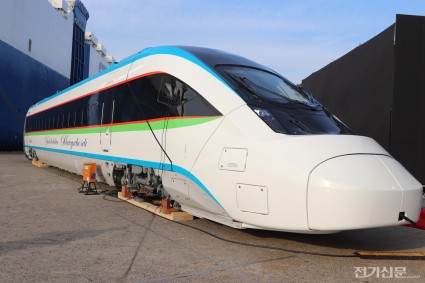
The "EMU-250" high-speed trains supplied by Hyundai Rotem to Uzbekistan consist of six trainsets (seven cars per train, totaling 42 cars). These trainsets are a modified version of the KTX-Eum, tailored to local conditions. Each trainset is 175 meters long, can accommodate up to 389 seats, and operates at a maximum speed of 250 km/h.
Currently, Uzbekistan operates with trains supplied by Spain's Talgo. Uzbekistan has chosen "Korean-made" trains for its new, second-generation high-speed trains. Distributed power trains, with power units installed in every car, offer the advantage of higher transport efficiency and acceleration/deceleration capabilities compared to centralized power trains.
The high-speed train will connect the capital city of Tashkent to the UNESCO heritage cities of Samarkand, Bukhara, and Khiva, a total distance of 1,286 km, operating at a maximum speed of 250 km/h. Tailored to the diverse climate of the region, including high desert temperatures, sandstorms, and extreme cold, the trains feature exterior urethane top coatings, dual aisles, and enhanced air conditioning systems.
Hyundai Rotem designed the trains with a custom design optimized for Uzbek's railway environment. Unlike Korea's standard gauge (1,435 mm), the Uzbek railway uses a broad gauge (1,520 mm), utilizing wider bogies and a powertrain compatible with the local power grid.
The train interiors are also designed to accommodate local operating conditions. Unlike the KTX-Eum, which only offers first-class and economy class seats, the Uzbek high-speed train offers three classes of seating: VIP, business, and economy. Considering the long distances, a separate dining car has been provided for light meals. Considering Uzbekistan's low platform height (200mm), steps have been installed for boarding and disembarking.
Lee Won-sang, Chief Technology Officer (CTO) and Head of the Rail Solutions Research Center (Managing Director) at Hyundai Rotem, stated, "Uzbekistan has a challenging environment, with temperatures reaching -40°C in winter and 40°C in summer, as well as desert sandstorms. We upgraded our trains to suit the Uzbek environment and developed a distributed powertrain that is on par with the upcoming SR high-speed trains."
He continued, "Uzbekistan uses AC 25kV 50Hz power supply, while Korea uses 60Hz, so the propulsion control system previously used in KORAIL and SR could not be used as is. Therefore, we redesigned the entire train and conducted thorough testing at a combined test facility to create a high-speed train optimized for the local environment."
Despite being the first overseas export, Hyundai Rotem's early delivery is possible thanks to over 30 years of experience in manufacturing and operating domestic high-speed trains. From the first domestically produced high-speed train, the KTX-Sancheon, to the KTX-Cheongryong, which began commercial operation last year, to the next-generation high-speed train, the EMU-370, development of which was completed this year, Hyundai Rotem has consistently mass-produced high-speed trains utilizing core national technologies.
Notably, the fact that the Uzbek high-speed train is based on the KTX-Eum, which has been in commercial operation in Korea since 2021, also contributed to the early delivery. Hyundai Rotem leveraged its experience in mass-producing the KTX-Eum to achieve optimized process efficiency throughout the entire process, from design to procurement and production.
Hyundai Rotem maintains a stable supply chain with domestic component suppliers, producing high-speed trains with a domestic production rate of 87%. Key electronic components, including propulsion control units, traction motors, and main transformers, are all produced domestically. This has also positively impacted the government's concessional export financing support, which closely examines the domestic production rate and the trickle-down effect on the domestic industrial ecosystem.
If all goes as planned, the first set of Uzbek high-speed trains to be exported will enter service in April 2027. Hyundai Rotem plans to supply all six sets by September 2027.
Executive Director Kim Jeong-hoon stated, "Given the small size of the domestic market, we must expand our global market share. We are actively pursuing overseas expansion, focusing on key markets such as Europe, North America, Australia, Asia, and North Africa."
He added, "Hyundai Rotem will continue to lead the domestic railway industry while growing in the global market and create opportunities for shared growth with our partners."