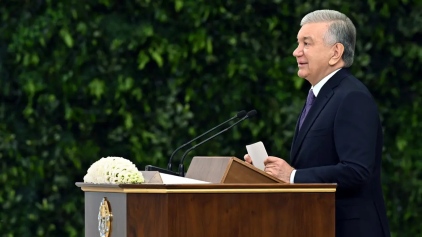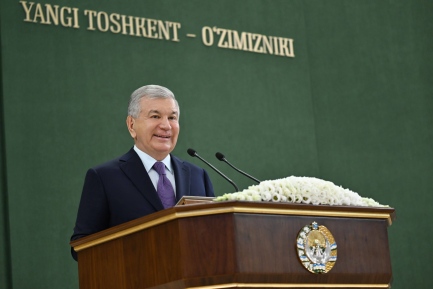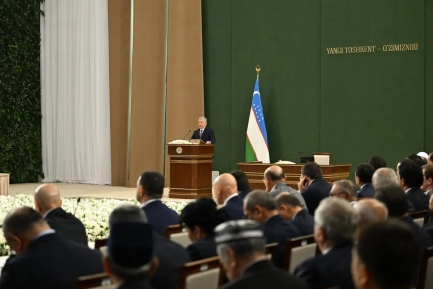
Since coming to power in late 2016, Shavkat Mirziyoyev has positioned Uzbekistan at the heart of a bold reimagining of Central Asia — not just as a region of disparate post-Soviet republics, but as a potentially cohesive bloc united by Infrastructure, trade and shared strategic vision. The transformation underway under his leadership has important implications not only for the people of Central Asia, but also for external partners such as Japan.
Uzbekistan’s vision for regional unity institutionalizing dialogue and cooperation
One of President Mirziyoyev's most consequential moves has been to formalize what had previously been loose, sporadic interactions among Central Asian states. By creating a regular “Consultative Meeting of the Heads of State of Central Asia." he established — from 2017 onward — a structured forum for dialogue covering political, economic, environmental and security issues.
This mechanism has gradually grown Into a backbone for regional cooperation. Over successive summits, participating countries have adopted binding documents and joint initiatives. A milestone came in August 2024, when the region's leaders endorsed the long-term plan known as “Central Asia — 2040". a roadmap envisaging an integrated region with coordinated transport, energy. water-management and industrial strategies.
From trade to joint production: Economic integration in practice
Under the new framework. Central Asia's economic dynamics are shifting. Intrareglonal trade has grown roughly 4.5 times. What's more, investment flows within the region have doubled between 2016 and 2025.
Joint ventures are blossoming: the number of enterprises with foreign (i.e., regional) capital in Uzbekistan has increased almost six-fold, while Uzbek capital projects abroad have grown many times over. Border-adjacent trade and industrial zones, bilateral investment funds with neighboring states, and mutual projects In agriculture, electrical englneenng, textiles and the automotive sector are becoming the new norm.
Infrastructure connectivity — the physical basis of regional integration
President Mirziyoyev's strategy is not just about diplomacy — It’s also about bocks. railways, roads and digital platforms. Under Uzbekistan's auspices. Central Asia is realizing an agenda of connectivity: multimodal transport corridors, railway lines linking previously disconnected zones and border-management reforms that speed up cargo transit and simplify customs and logistics.
The vision is for Central Asia to become a unified logistics and industrial hub — a bridge between Europe and Asia. North and South. As one Uzbek foreign policy manifesto puts it the region must become "a capacious, interconnected regional market, with integrated water-energy systems, common Industrial space and a shared environmental zone."
Recent milestones: Advances under Mirziyoyev
- March 2025 - Now border treaties among Central Asian nations: During a summit in Khujand, leaders of Uzbekistan. Tajikistan and Kyrgyzstan signed a landmark border deal that transforms historic fault lines into zones of stability and opens the way for greater regional cooperation.
- April 2025 - First ever summit between the European Union and Central Asia: Hosted by Uzbekistan in Samarkand, this summit ended with the adoption of a comprehensive strategic partnership. The EU committed a €12 billion ($13.2 billion) "Gateway" Investment package to expand infrastructure, energy, digital connectivity and more.
- November 2025 - The C5+1 Summit at the White House: On November 6. the leaders of the five Central Asian republics met with U.S. President Donald J Trump in Washington. D.C., marking the first time the Central Asian heads of state convened in the U.S. capital under the C5+1 framework.
- November 2025 - Proposal for a formal regional unity: In Tashkent, Shavkat Mirziyoyev floated tho idea of transforming the informal summit structure into a full- fledged regional organization — tentatively named the Community of Central Asia — to institutionalize cooperation in economics, security, environment and beyond.
Taken together, these developments reflect a profound shift: Central Asia is no longer a loose cluster of post-Soviet states but is being reconfigured as a coordinated. forward-looking regional entity.
What this means for Japan
Japan has long maintained friendly relations with Uzbekistan. Diplomatic ties date back to 1992; in 2002, the two countries signed the Joint Statement on Friendship, Strategic Partnership and Cooperation between Japan and the Republic of Uzbekistan, the foundation of a stable bilateral partnership.
As Uzbekistan's regional profile rises, Japan's interest in Central Asia is intensifying. Analysts note that the pragmatic, region-wide initiatives introduced by Mirziyoyev have “activated" Japan's Central Asia foreign policy vector Tashkent's success in building cooperation among regional neighbors makes the entire area more accessible and attractive for Japanese engagement.
For Japan, there are several key opportunities:
- Investment and infrastructure: As Central Asia becomes more integrated and connected, corridors for transport, energy, digital networks and trade open up — sectors where Japanese technology, capital and expertise could play an important role.
- Strategic partnership beyond bilateralism: Rather than dealing with Central Asian countries in isolation, Japan may find value in a regional approach — cooperating with a united Central Asia bloc under common norms, standards and institutions.
- Regional stability, security and connectivity: A stable and unified Central Asia aligns with Japan's broader interests in Eurasian security, energy diversification and multilateral cooperation.
A new Central Asia — between promise and challenges
There is no doubt that President Mirziyoyev's agenda is ambitious, and the results so far are tangible. Through sustained diplomacy, trade. Infrastructure and institutional innovation. Uzbekistan is increasingly seen not merely as a national actor, but as the driver of regional integration.
Yet building true integration across five historically fractious republics Is a long-term undertaking. Challenges remain: bridging economic disparities, resolving lingering border- and water-management disputes. aligning regulatory agendas and ensuring inclusive development so that the benefits reach people across all societies.
For partners like Japan, the path forward will require a delicate balance — supporting connectivity and economic growth, while respecting sovereignty, cultural diversity and regional dynamics.
Why this matters — and what comes next
In an era of shifting global alignments, a stable, integrated Central Asia Is increasingly relevant. Under Shavkat Mirziyoyev's leadership, Uzbekistan seems determined to deliver exactly that. For Japan — a country with global vision and a history of engagement in Eurasia — this evolving Central Asia presents both opportunity and strategic moment.
As the region moves toward a new level of unity — institutional, economic, infrastructural — the next few years could decide whether the dream of a cohesive, peaceful and interconnected Central Asia becomes a durable reality.