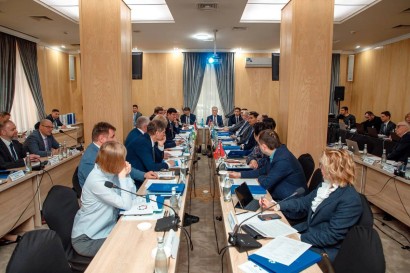
Tashkent hosted the 26th meeting of the CIS Commission on Peaceful Uses of Atomic Energy Wednesday, which was attended by officials of the nuclear authorities of Uzbekistan, Russia, Armenia, Belarus, Kazakhstan, Kyrgyzstan, and Tajikistan.
In his opening remarks, the Deputy Director of the Atomic Energy Agency of Uzbekistan (Uzatom) Nozim Muksinov emphasized that holding the meeting in the country was "testimony to Uzbekistan’s becoming an active player in the international nuclear energy dialogue."
The chairman of the commission, First Deputy Minister of Emergency Situations of Kyrgyzstan, Azamat Mambetov said that the development of nuclear energy is only possible with the highest standards of safety and responsibility.
Our common goal is to create safe, efficient, and eco-friendly solutions that will benefit our people, he emphasized.
Extensive work is underway In Uzbekistan to foster a favorable public opinion about the nuclear industry and the nuclear plant project, as well as to build capacity of human resources, said Nozim Muksinov, emphasizing nuclear safety. Uzatom previously announced that public hearings on the NPP construction project would be held on December 23.
Uzbekistan is also comprehensively developing the use of peaceful nuclear energy in civilian applications, stated Nozim Muksinov. Specifically, projects in this area include the creation of a modern nuclear medicine infrastructure to improve the diagnosis and treatment of cancer patients, as well as the introduction of radiation technologies in the agricultural sector, he added.
Small Modular Reactors and Large Waste
The meeting was held behind closed doors, but the practical results were announced to the press. According to Azamat Mambetov, one of the key issues was the use of small nuclear reactors. This technology is already being used in Russia and is being considered for implementation in Uzbekistan and Kyrgyzstan.
"Many countries are transitioning to this energy source," he noted.
Furthermore, the participants discussed the progress of the interstate program for the reclamation of territories affected by uranium mining and approved a report on the implementation of the action plan for 2021-2025 as part of the CIS cooperation program for the peaceful use of nuclear energy until 2030.
The discussion of peaceful nuclear energy in Tashkent also touched on several long-term environmental and technological challenges facing CIS countries, where the parties envisage the use of nuclear technology.
One of these is the stockpiles of unused pesticides accumulated over decades. In Central Asian countries, their volume is estimated to reach 25,000 tons, and in Russia, approximately 20,000 tons.
Azamat Mambetov noted that this wasn't just about stored waste, but a direct threat to soils and ecosystems.
Creating a landfill specifically for unused pesticides was discussed; this requires proper disposal, the commission chairman noted.
The second topic relates to the rapid growth of electric transport. The widespread use of electric vehicles raises the issue of recycling lithium batteries and storage batteries. According to Azamat Mambetov, the region is already developing conditions for recycling batteries and producing new ones. "Of course, without scientific approaches, there would be no development in this area, he emphasized.