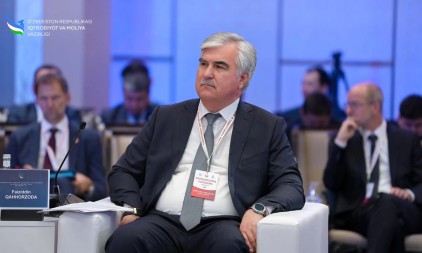
Trade turnover between Uzbekistan and Tajikistan crossed the $700 million mark by 2025, and both nations aim to push this figure to $2 billion by 2030. This was announced by the Minister of Finance of Tajikistan, Fayziddin Kakhhorzoda, during a regional cooperation seminar focused on enhancing connectivity, attracting private investment, and developing open trade.
According to the minister, regional companies are expanding into neighboring markets at an accelerating pace, making cross-border private capital investment a defining trend in Central Asia. Specifically, Tajikistan's total trade volume with fellow Central Asian nations reached over $2 billion by 2025, accounting for more than 20% of the country’s total foreign trade.
Kakhhorzoda paid special attention to the partnership with Uzbekistan.
"Our interaction with the Republic of Uzbekistan stands as a prime example of successful regional cooperation. By 2025, bilateral trade between Uzbekistan and Tajikistan exceeded $700 million, which makes up over 23% of our overall trade portfolio," he stated.
The minister added that in January of this year alone, trade with Uzbekistan surpassed $200 million, marking a growth of nearly 12%.
"The leaders of our two nations have set a clear mandate for us to elevate this trade volume to $2 billion by 2030," Kakhhorzoda noted.
According to Kakhhorzoda, a robust economic cooperation system has taken shape between the two countries, characterized by the creation of joint ventures, growing mutual investments, digital financial services, industrial cooperation, and new supply chains.
"We are pleased to see that over 400 companies with Tajik capital are operating in Uzbekistan, while more than 160 companies with Uzbek investors are registered in Tajikistan. This is clear evidence of our strong collaboration," the minister stated.
He noted that the private sectors of both nations increasingly view their neighboring country as a viable market for business expansion and long-term development.
As a prime example of successful Tajik business in Uzbekistan, Kakhhorzoda highlighted Alif, a company driving digital financial services and electronic payments. "In Uzbekistan, Alif ranks second in revenue within its sector," he said.
According to him, this success story demonstrates the potential of expanding and integrating regional financial and capital markets to boost Central Asia's attractiveness to international financing.
Representing Uzbek business success in Tajikistan, the minister cited the Artel Avesto Electronics project. "The company operates in the real sector of the economy, manufacturing household appliances, creating local jobs, and continually expanding its production capacities in our country," he noted.
To support the private sector and foster collaboration between the business communities of both nations, the Uzbek-Tajik Investment Company was established with a capital of over $50 million.
"This mechanism is designed to serve as a practical tool for financing joint projects across manufacturing, agricultural processing, logistics, and small and medium-sized enterprises (SMEs)," Kakhhorzoda said.
The minister also reported that as of July 1, 2026, there were 112 business entities operating in Tajikistan with Kazakh capital, 42 with Kyrgyz capital, and 12 with Turkmen capital.
"I am confident that a similar process is unfolding across neighboring Central Asian nations, where regional companies are actively operating in each other's markets. This practice of mutual private capital participation is becoming a prominent regional trend, and these examples hold great significance for the broader regional agenda," he emphasized.
Furthermore, Kakhhorzoda highlighted the importance of regional initiatives backed by international financial institutions, specifically referencing CASA-1000 (the Central Asia-South Asia power project).
"The project is valued at $1.2 billion. It establishes the critical infrastructure needed to transmit over 1,400 MW of electricity from Kyrgyzstan and Tajikistan to Afghanistan and Pakistan," the minister stated.
According to him, for Tajikistan, this means expanding revenue streams, utilizing its summer hydropower potential more efficiently, and establishing a direct energy link between Central and South Asia.
He also highlighted the REMIT program, approved by the World Bank in January 2026, which aims to create the first regional electricity market in Central Asia.
Under the fourth phase of the Central Asia Regional Links program, Kakhhorzoda noted that over $130 million has been allocated for Tajikistan to develop cross-border highways, increase road travel speeds, and modernize customs infrastructure.
"If the existing potential is unlocked effectively, Central Asia can transform from a mere transit corridor into a self-sustaining hub for manufacturing, processing, trade, and digital services," the Minister of Finance of Tajikistan concluded.
Over the past 30 years, relations between Uzbekistan and Tajikistan have undergone a profound evolution—moving from a period marked by travel visas and landmined borders to the establishment of a formal strategic alliance. Bilateral trade is now approaching $1 billion, and the two nations continue to expand their industrial cooperation.
Stay up to date with all the latest news: