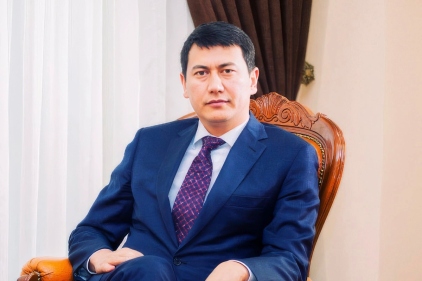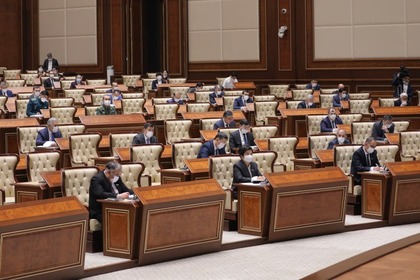
At its 17th plenary session today, the Senate approved the constitutional Tashkent International Financial Center Bill, the press service of the Senate reported.
The document aims to improve the investment climate, attract international capital, and build a modern financial infrastructure. The law was previously reviewed during the Senate's 16th plenary session but was rejected and sent back to the Legislative Chamber for revision.
A conciliation commission, composed of senators and deputies, subsequently refined the law in collaboration with representatives from relevant government agencies and organizations.
A special regulatory framework will be established within the center to govern banking, investment, insurance, securities market operations, payment systems, Islamic finance, financial technology, auditing, consulting, legal, and other professional services.
It was further noted that the document codifies a distinct status for the center's participants, offering special privileges, including tax and other incentives. It also introduces practical conveniences for foreign investors and specialists, particularly regarding entry and exit procedures.
Specifically, financial center participants will be permitted to hire foreign specialists without the need to obtain work permits. Additionally, foreign citizens and stateless persons associated with the financial center will be eligible for entry visas valid for up to five years.
According to the speaker, following the conciliation commission's work, the regulations protecting the funds and data of the center's participants were brought into alignment with international principles and standards for countering money laundering and the financing of terrorism.
"Tax and visa privileges have been significantly refined. It is now clearly defined who can benefit from these incentives and under what conditions. The law establishes criteria for program participation, minimum investment thresholds, requirements regarding the source of funds, beneficial ownership, tax residency determination, and substance requirements," he stated.
Erkin Gadoev also reported that while the principles of free capital movement and profit repatriation remain intact, a mechanism coordinating this process with the Central Bank has been formally institutionalized.
During the discussion, Senator Jamilya Kholmurodova noted that the Tashkent International Financial Center is the first of its kind in the country’s history and will operate under a special legal regime.
Responding to her question about the center's projected economic impact, Shokhrukh Gulamov, the Acting Deputy Minister of Investment, Industry, and Trade, mentioned that the experiences of Kazakhstan and the UAE were analyzed during the revision of the law.
"Kazakhstan's financial hub has been active since 2018. According to our projections, it has attracted over $20 billion in investment since then, with more than 1,900 international companies registered and around 1,000 jobs created within Kazakhstan itself," he said.
He added that the Dubai International Financial Centre has been operating since 2004, hosting over 4,800 registered international companies and employing more than 50,000 highly qualified professionals.
Shokhrukh Gulamov stated that according to preliminary projections, the Tashkent International Financial Center could attract $20–25 billion in annual investment into the economy by 2030 and contribute at least 1% to the GDP. "Furthermore, the most crucial aspect is the human capital—the specialists who will be drawn to work at the center. We estimate that over 10,000 Uzbek and international professionals will find employment there," he said.
He also noted that the center's operations could help boost the country's sovereign credit rating.
During a government meeting chaired by the president on March 26, it was emphasized that the Tashkent International Financial Center will serve as an effective instrument for attracting new types of investment and securing sustainable economic growth.
The hub plans to implement a framework based on English common law, its own independent court system, and tax exemptions spanning the next 50 years—until 2076. Additionally, seven articles of the country's Criminal Code will not apply within its jurisdiction.
Stay up to date with all the latest news: