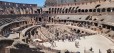
Walk up to the Colosseum any morning between April and October and you'll see the same scene: 200 people on a queue that doesn't move, a dozen guides holding up coloured umbrellas, and tourists asking each other "did you also pay extra for the underground?" The answer half the time is "I don't know, I think so".
The Colosseum tour market is one of the most confusing in Europe. There are at least five different levels of access, four ticket categories, and roughly thirty operators selling them under names that sound almost identical. This article cuts through that. It explains what the underground actually is, what the arena floor is, which level of access matters for which visitor, and how to pick a tour without paying for things you won't use—or skipping things you'd have wanted.
Quick check: which level of access do you actually need?
1. How much do you care about gladiators specifically?
2. Are you visiting Rome with kids?
3. Do you have a half-day or a full day for Ancient Rome?
Why the Colosseum without a guide is confusing on purpose
The Colosseum site receives roughly 7 million visitors a year. To manage the flow, the Italian Ministry of Culture has split the experience into tiered access levels, each with its own ticket. The official ticketing site is honest about this but not particularly clear, and the third-party resellers are clear but not always honest.
Three specific things get lost without a guide:
- The geography of the building. The Colosseum had 80 entrances, numbered to control 50,000 spectators in under 15 minutes. Today most visitors enter through the same gate and assume that's how it always worked.
- What the rubble in the centre actually is. The brick-and-stone maze at the bottom of the arena is the hypogeum, the basement. Without context it looks like a destroyed cellar. With context it's the most sophisticated piece of stage machinery in the ancient world.
- The order of access. Even with the right ticket, the route matters: underground first, then arena floor, then upper tiers makes narrative sense. The reverse leaves people standing on the arena floor wondering what they're supposed to be looking at.
The four levels of Colosseum access, explained
| Access level | What's included | Guide required? | Typical price |
|---|---|---|---|
| Standard | Colosseum ground level + upper tier + Roman Forum + Palatine Hill | No | €18-€22 |
| Arena Floor | Standard + access to the reconstructed wooden arena floor | No (but timed entry) | €24-€28 |
| Underground (Hypogeum) | Standard + descent into the underground tunnels and chambers | Yes, mandatory | €65-€95 (with tour) |
| Full Experience / VIP | Standard + Arena Floor + Underground + Belvedere (third tier) | Yes, mandatory | €90-€160 (with tour) |
What you'll actually see at each level
Standard access (€18-€22)
You walk in through the Gladiator's Entrance, climb to the second tier, and walk around the perimeter. You can look down into the underground from above (and the structure is impressive from this angle), but you cannot enter it. You get the Roman Forum next, which is sprawling and badly signposted but free with the same ticket. The Palatine Hill, where the emperors lived, is included and almost always empty.
Best for: first-time visitors who want to see the building, have read up on the history beforehand, and aren't planning a longer Rome trip where they'd return.
Arena floor access (€24-€28)
Everything in Standard, plus access through a side gate to the reconstructed wooden floor that covers part of the underground. You stand at the exact level where the gladiators stepped out. The view back at the tiered seating, from this position, is the single most cinematic perspective the building offers. Photographs come out completely differently from here.
Best for: families with kids, anyone who's grown up with Gladiator or any of the recent films, photographers.
Underground (hypogeum) access (€65-€95 with guide)
You go down a flight of stairs into the brick chambers below the arena. This is where animals were caged in side rooms, where lifts were operated to raise gladiators onto the floor mid-fight, where wooden machinery created changes of scenery during games that ran for 100 days at a stretch. It's narrow, atmospheric, and requires a guide because the corridors are too tight for self-guided visitors to be managed safely.
Best for: visitors with a strong interest in Roman history, second-time Rome travellers, anyone who'd happily watch a documentary about gladiators.
Full Experience (€90-€160)
Underground + arena floor + Belvedere (the third tier, normally closed). Belvedere offers the highest viewing angle of the arena, used by senators and emperors. Tours last 3-3.5 hours and include the Forum and Palatine Hill afterwards. This is the maximum-access option and the one that requires booking longest in advance.
Best for: visitors prioritising the Colosseum as the main reason for their Rome trip, anyone who's been to standard Colosseum before and wants to go deeper.
Tour formats compared
| Tour type | Group size | Duration | Price range | Underground included? |
|---|---|---|---|---|
| Skip-the-line group tour | 20-30 | 2 h | €40-€60 | No |
| Small-group archaeologist tour | 8-15 | 3 h | €80-€130 | Some, check name |
| Underground + Arena small-group | 8-12 | 3-3.5 h | €110-€160 | Yes |
| Private tour with licensed guide | 1-8 | 3-5 h | €250-€600 per group | Yes (upon request) |
How to choose the right tour: green flags and red flags
Green flags. The booking page names the specific access level included ("Arena Floor" or "Underground" written explicitly, not just "VIP"). Skip-the-line entry is stated, not just "fast track". The guide is described as "officially licensed by the Lazio region" or "archaeologist guide". Group size cap is in writing.
Red flags. "Exclusive underground access" without a specific entrance time. Tours under €50 that claim to include the underground (mathematically impossible given the ticket cost). Generic photos of the arena floor used in the marketing of a tour that doesn't include it. Reviews mentioning the guide "rushed through" anything.
The kinds of operator that actually run Colosseum private tours
- Walks of Italy runs an archaeologist-led small-group VIP tour with underground access, well-rated and one of the longest-running in the city. Mostly English-speaking.
- LivTours operates semi-private tours (max 6 people) with exclusive arena access. Higher price tier but tight execution.
- The Tour Guy offers privileged-entrance options across the Colosseum-Vatican axis.
- For travellers who want a full private day with door-to-door pickup, a Spanish or French speaking licensed guide, and the Colosseum + Forum bundled into a wider Rome itinerary, agencies like Tour Travel & More handle that format. Their model is 100% private, with luxury vehicle and chauffeur, licensed guide and a 24/7 coordinator service for last-minute changes. You can see a private tour of Rome and the Colosseum with a licensed guide and luxury vehicle for the standard format, with the option to combine it with the Vatican in the same day.
Getting in: timing, tickets and the queue problem
The Colosseum opens at 8:30 a.m. and closes between 4:30 and 7 p.m. depending on the season. The official ticket sales open online 30 days in advance, in waves. Underground tickets specifically open in batches and sell out within hours. If you're planning more than 60 days ahead, set a calendar reminder. If you're inside 30 days, your only path to underground is a guided tour where the operator has pre-purchased slots.
The queue at the Colosseo entrance is famous but solvable: skip-the-line is included with almost every paid tour. The queue at the Roman Forum is shorter and less stressed, so if you have standard tickets without time slot, enter from there and walk back into the Colosseum, against the flow.
Best time to visit
Tuesday and Thursday mornings (8:30-10:30) are the calmest moments of the week. Wednesdays are the worst because of papal audiences spillover from the Vatican. From late June to early September, afternoon visits become punishing: the Colosseum is largely unshaded and the brick reflects heat. Either go very early or wait until 4 p.m. when the angle of the sun changes and the temperature drops.
Frequently asked questions
Is the Colosseum underground worth the extra money?
Can I buy underground tickets directly from the Colosseum website?
What's the difference between Arena Floor and Underground?
How long is a typical Colosseum tour?
Is the Colosseum tour accessible for people with reduced mobility?
Can I combine the Colosseum and the Vatican in one day?
How much should I budget for a Colosseum tour?
Are guided tours available in Spanish?
The verdict
Pick the access level before you pick the tour. The Colosseum is the same building whether you visit it with the cheapest or most expensive ticket, but what you actually do inside changes dramatically. For most first-time visitors, arena floor access plus a licensed guide hits the sweet spot: cinematic, manageable, and not crazy expensive. For visitors with deeper interest, underground access is the upgrade that pays back the cost.
If you're planning Rome as part of a longer trip and want a fully tailored day (Colosseum + Forum + Palatine, with the Vatican stacked into the same day or split into two days), the most reliable format is a private full-day tour of Ancient Rome with a licensed guide and private vehicle that handles ticket coordination, picks you up at your hotel and adapts pace to your group. Whichever route you choose, decide the access level first and the operator second; the access decides what you see, the operator decides how you see it.