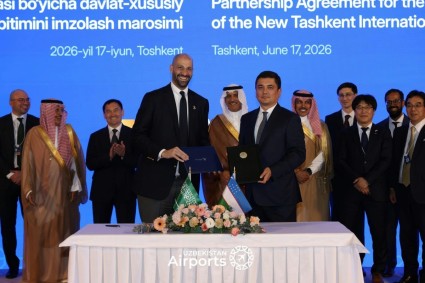
Uzbekistan Airports, the state airport operator of Uzbekistan, and an international consortium led by Saudi Arabia's Vision Invest have signed a public-private partnership (PPP) agreement to construct and operate the new Tashkent International Airport, according to the company’s press service.
The agreement was signed on June 17 on the sidelines of the Tashkent International Investment Forum. The consortium also includes Japan's Sojitz Corporation and South Korea's Incheon International Airport Corporation.
As previously reported, the shares within the international consortium are distributed as follows:
- Vision Invest: 45%
- Sojitz Corporation: 30%
- Incheon International Airport Corporation: 15%
- Uzbekistan Airports: 10%
The signing followed extensive preparatory work. This included environmental and social impact assessments conducted in accordance with international financial institution standards. Additionally, the PPP agreement was drafted, engineering utility relocation plans were finalized, and site preparation for the future airport commenced.
"It is important to emphasize that this airport project was developed under the initiative of the nation's President, with the full support of the government, the Ministry of Economy and Finance, and the Ministry of Transport. Today, we have taken a major step toward its realization," stated Zhavlonbek Umarkhodjaev, Chairman of the Board of Uzbekistan Airports.
"By partnering with leading international companies, we are gaining more than just investment; we are acquiring unique expertise in designing, building, and managing some of the world's largest airport complexes using cutting-edge technologies. I am confident that this project will mark a new milestone for Uzbekistan’s aviation industry and cement our country's position as the primary transport hub of Central Asia," he noted.
The airport will span 1,310 hectares across the Urtachirchik and Kuyichirchik districts of the Tashkent region.
The first phase of development includes:
- Runways: Two 4-kilometer runways
- Passenger Terminal: A 208,000-square-meter facility
- Aircraft Stands: 98 designated parking spots
- Infrastructure: A dedicated fueling complex and a modern air traffic control tower
Construction is scheduled to begin in July of this year, with the airport expected to open by late 2030. Once fully operational, it will have the capacity to handle up to 20 million passengers and 300,000 tons of cargo annually.
Under the agreement, the private consortium will manage the construction and long-term operations of the passenger terminal and the airport landside area. The state partner retains responsibility for building and operating the airfield complex.
According to the approved schedule, engineering utility relocation and final site preparation will begin this June, paving the way for phased construction works. The development of the capital's new airport was officially mandated by a presidential decree issued on November 25, 2025.
Stay up to date with all the latest news: