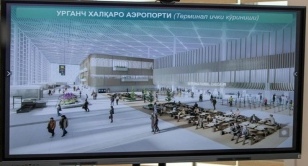
Uzbekistan Airports on September 29 showed journalists the site of the future passenger terminal at Urgench International Airport, which is being built by South Korea's Incheon International Airport Corporation.
The old arrivals terminal on the site has been fully demolished, and the area has been cleared and leveled. Special concrete piles are being driven in for the foundation to stabilize the ground. In all, 1,495 piles will be installed.
Hwang Yeong-je, the construction manager for contractor BoMi Engineering & Construction of South Korea, said the piles are needed because of the soil in Urgench, where the upper layers are saturated with water and not stable enough. The piles, about 12 meters long, pass through those layers and rest on dense, dry clay. The foundation will then be poured, followed by the erection of steel structures.
To keep the airport running during construction, the Korean side built a temporary arrivals terminal, airport director Oybek Matkarimov said. It is a lightweight hangar made of sandwich panels. Flights are being handled there while construction continues, and the hangar will be dismantled once the new terminal is ready.
About the project
The project is being implemented as a public-private partnership (PPP) under a build-operate-transfer model. It runs for 22 years, including three years of construction.
Preparations began in 2024. The Cabinet of Ministers first approved a concept, followed by a two-stage international tender. Incheon International Airport Corporation was declared the winner on April 17, 2025.
The project company, ICN-Urgench Airport Services, was set up in November 2025, and on December 26 a PPP agreement was signed in Tashkent between Uzbekistan Airports, Urgench airport and the company. On March 2, 2026, the Ministry of Economy and Finance signed a state support agreement with the project company.
Matkarimov said eight companies took part in the tender. Bidders were assessed on how much they would grow passenger traffic, how much they would invest, what technology they would bring and what experience they had.
"Under the PPP, the private partner builds a terminal to serve passengers. Auxiliary buildings, a catering building and a cargo terminal are also planned. On the state side are the main runway, taxiways and aprons," Matkarimov said.
The total cost of the project is $242 million, of which $134 million is for the private partner's facilities and $108 million for state facilities.
The terminal is being designed by Kirin Design of South Korea, construction supervision is by Samsung, and the work is being carried out by BoMi Engineering & Construction. Matkarimov explained why Incheon and BoMi were chosen.
"Incheon is among the world's top 10 airports. Over the past five years, it has twice ranked first for passenger traffic and passenger service. They have a great deal of experience, and there is much to learn. As for the builder, it is BoMi. If you've seen Tashkent City, BoMi has a 30-story building there. They are reliable builders; that is our view," the airport director said.
Yoo Byeong-nam, Incheon's PPP project head in Urgench, spoke to journalists on behalf of the company. He has worked at Incheon for more than 20 years in airport facility operations and has taken part in major construction projects.
"The core of operations for Incheon is service. We are not saying service at existing airports in Uzbekistan is bad. In almost 25 years, we have built up our own standards and experience in making departures and arrivals comfortable, convenient and fast. We want to bring that experience to Urgench," Yoo said.
He said Incheon and Samsung specialists from South Korea are being brought in to set up ICT, power supply and other specialist systems, while the Korean side is also training local staff. Yoo stressed that Incheon will operate the airport for 19 years from 2029, and is therefore already recruiting people who can work in airport operations.
What the new airport will look like
The airport was founded in 1932 and last modernized in 2014. It is 3 km from the center of Urgench and about 30 km from Khiva, and covers 294 hectares.
The runway will be lengthened from 3,000 to 3,300 meters and surfaced with concrete. There will be four taxiways instead of one, plus a high-speed taxiway. The number of aircraft stands will rise from six to 18. The airport currently accepts aircraft up to Code E. After construction, the runway, taxiways and stands will be designed for Code F aircraft such as the Boeing 747-8 and Airbus A380.
By the end of 2028, a cargo complex, parking for about 1,000 vehicles, catering facilities and a complex for special vehicles are also planned. The project also includes a technical service center of more than 1,000 square meters, a heated garage of about 900 square meters for snow-clearing equipment and a wash for special vehicles. A forecourt of about 20,000 square meters with new access roads and pedestrian zones will be built in front of the terminal.
The new terminal will be directly linked to the railway station. The electric train journey from Urgench airport to Khiva takes 47 minutes.
In the first eight months of 2026, Urgench airport handled 800,000 passengers. Its current capacity is 1.2 million. Passenger traffic is forecast to reach 3.4 million by 2047, and cargo volume to grow from 196 metric tons in 2025 to 1,152 metric tons in 2047.